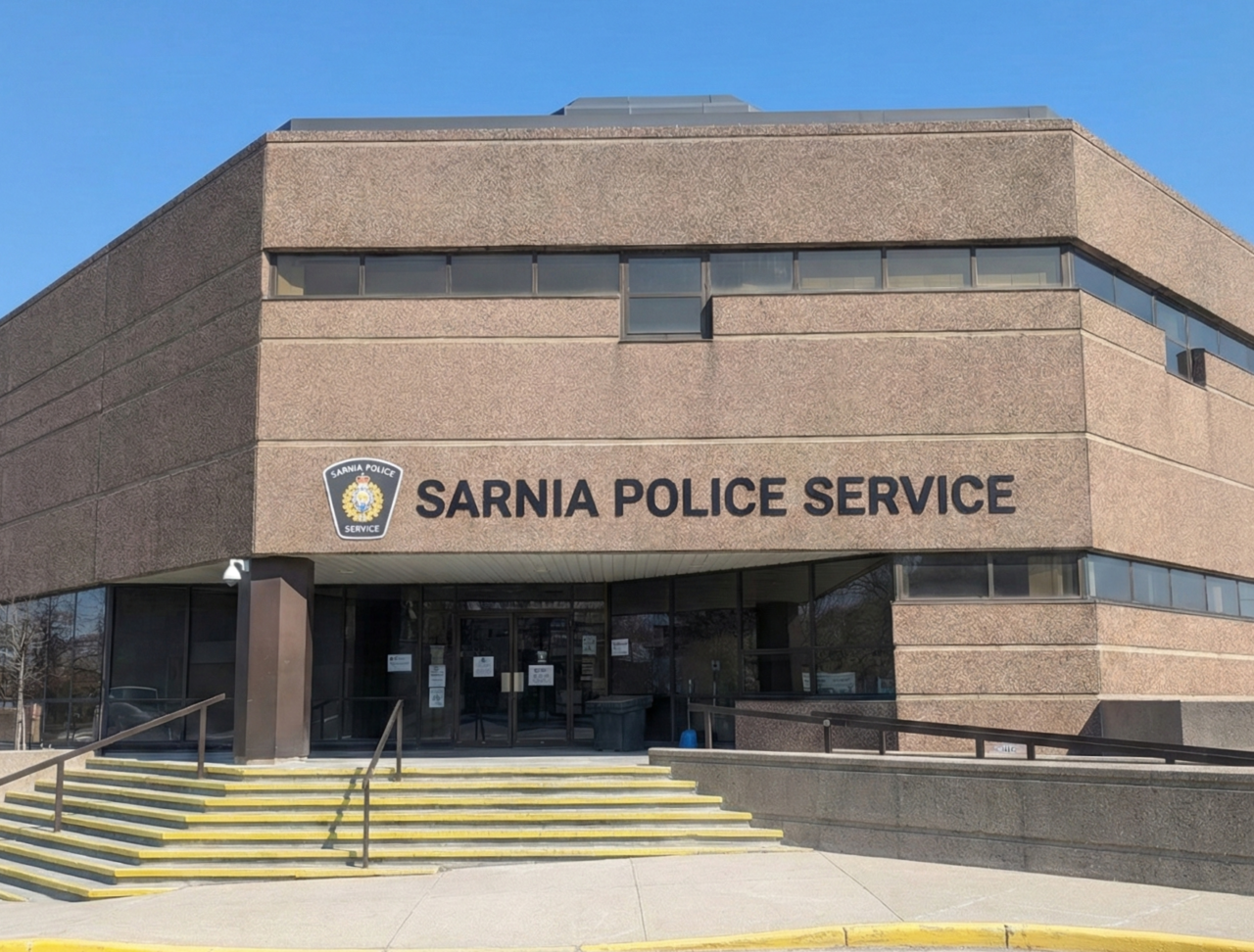
Information identifying or describing more than $672,000 in spending was redacted from selected Sarnia Police technology and operational accounts obtained through freedom of information requests by *The Sarnia Journal*. The annual total rose from about $101,600 in 2023 to $304,100 in 2025 — nearly tripling in two years. Police board chair Kelly Ash has forwarded the findings to an investigative team and those conducting a forensic audit, and says she is suspicious about the blackouts herself.
The increase accelerated sharply. Redacted spending rose by roughly $57,200 between 2023 and 2024, then by another $145,300 the following year. By 2025, nearly 90 per cent of the Intelligence Program Supplies account and about 85 per cent of the Electronic Crimes Program Supplies account had identifying information removed from the public version of the ledger.
Altogether, approximately $672,670 in transactions between June 1, 2022 and May 4, 2026 appear under “Redacted Operational Security,” “Redacted IT Security” or similar blackouts. That figure represents about 7 per cent of the roughly $9.59 million recorded across the five ledger groups obtained — IT systems and connectivity, technology licensing and maintenance, police operational supplies, other supplies and services, and radio communications. It does not represent all Sarnia Police spending during the period.
The redactions hide information that could identify the vendor or describe what was purchased, while leaving the transaction itself visible in the ledger. The public can see that money was spent, and in some cases how much, but not who was paid or what was bought.
*The Sarnia Journal* filed the freedom-of-information requests on April 9 while seeking financial records in connection with the defamation lawsuit brought by Chief Derek Davis against the Journal. The service denied the requests on May 1. The ledger was ultimately released following an appeal.
Ontario law allows police to withhold certain law-enforcement and security information. A redaction is not proof of wrongdoing. What the records do show is that the dollar value of transactions containing redactions increased in each full year from 2023 through 2025, nearly tripling over that period, while two specialized accounts became overwhelmingly obscured.
On August 12, a summary of the redacted figures was provided to the Sarnia Police Services Board. Ash replied that the material had been forwarded to the appropriate investigative team and to those already conducting a forensic audit. After clarification that the question concerned the criminal investigation connected to the complaint against Davis, she wrote: “I assure you, they have full access.”
She then asked for the records herself.
“I’m just suspicious as to why it was blacked out,” Ash wrote. “I want to look into it myself.”
The increase in redactions coincided with a broader expansion of technology and analytics within the service. Official police documents state that an SPS Analytics Unit was introduced in 2022 and developed systems integrated with the service’s computer-aided dispatch and records management. The service has described the years since 2022 as a period of significant modernization.
Davis was suspended with pay in May after the Police Services Board launched an independent investigation following a workplace harassment complaint. Separately, a complaint retained by the Law Enforcement Complaints Agency alleged concerns involving Davis’s financial interest in Norigen Management Consulting Inc. and the hiring of Joseph Glover, described in the complaint as his business partner, into an analytics-related role. LECA later suspended the commencement of its investigation after being informed that the matter had become the subject of a criminal investigation.
The records do not name the vendors, describe what was purchased under the redactions, or explain why the shielded amount nearly tripled. They do not establish a connection between the blacked-out spending and any particular person or company.
The acceleration occurred during the same period in which the service was expanding its analytics capacity. Separate formal complaints would later raise questions about leadership decisions involving that analytics work. The records reviewed here do not establish a connection between those complaints and the redacted spending.
What they do leave is an open and growing set of questions about why so much spending in these accounts was placed beyond public view, and why the volume of those blackouts accelerated so sharply.
The board chair has now seen the pattern, expressed her own suspicion, and said investigators have full access to the information withheld from the public. The findings have also been provided to those conducting a forensic audit.
The public still does not.
Originally published in The Sarnia Journal.
