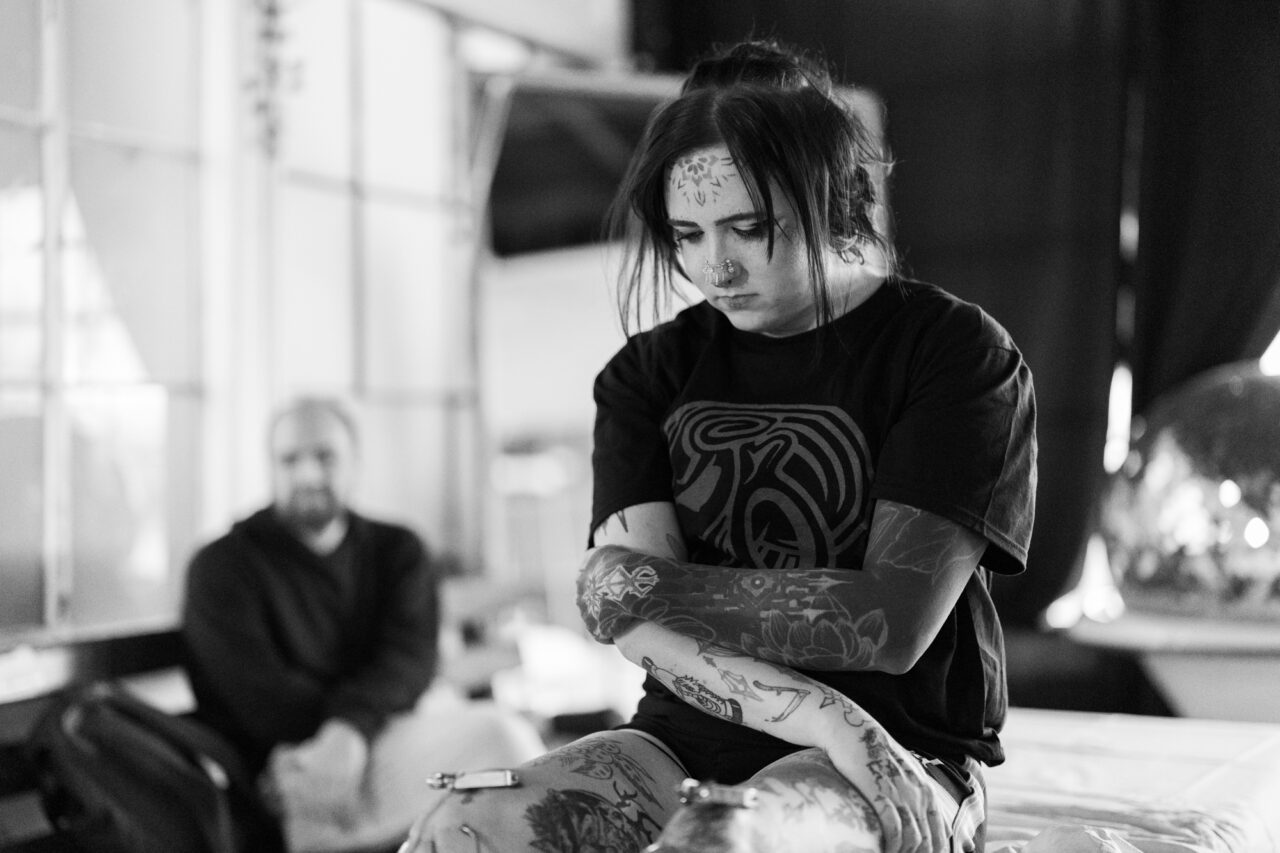
Content Warning: This article contains photographs and descriptions of body suspension and piercing that some readers may find graphic or unsettling. All suspensions depicted were performed by experienced practitioners within a controlled environment, with informed consent from participants.
In a warehouse overlooking Toronto’s industrial west end, a group of body suspension practitioners gather to test the limits of trust, autonomy and pain. While a high-decibel metal soundtrack—"Squier Talk" by Vianova—creates a wall of sound loud enough to make casual conversation nearly impossible, the room remains focused on the deliberate, technical movements of a ritual that dates back centuries.
Maddie, a writer and musician from Sarnia, lies on a table in a vast room defined by massive floor-to-ceiling grid windows and a gilded mirror. For her, this isn't a new world, but the evolution of a journey that began with her first piercings at age eight. "I’m living the life as an adult that I used to wish for as a child," she says, reflecting on a lifetime spent seeking out communities built around these practices. Surrounding her is the Ontario Suspension Collective (OSC), a radical community of mutual aid.
The Technical Gift
The preparation is clinical, yet deeply intimate. Norman Melnick and Kevin Donaghy, senior practitioners within the collective, lean over Maddie’s knees. Their conversation is strictly technical, a peer-review debate regarding the exact placement of the hooks to ensure they catch the "bowl" of the skin correctly.
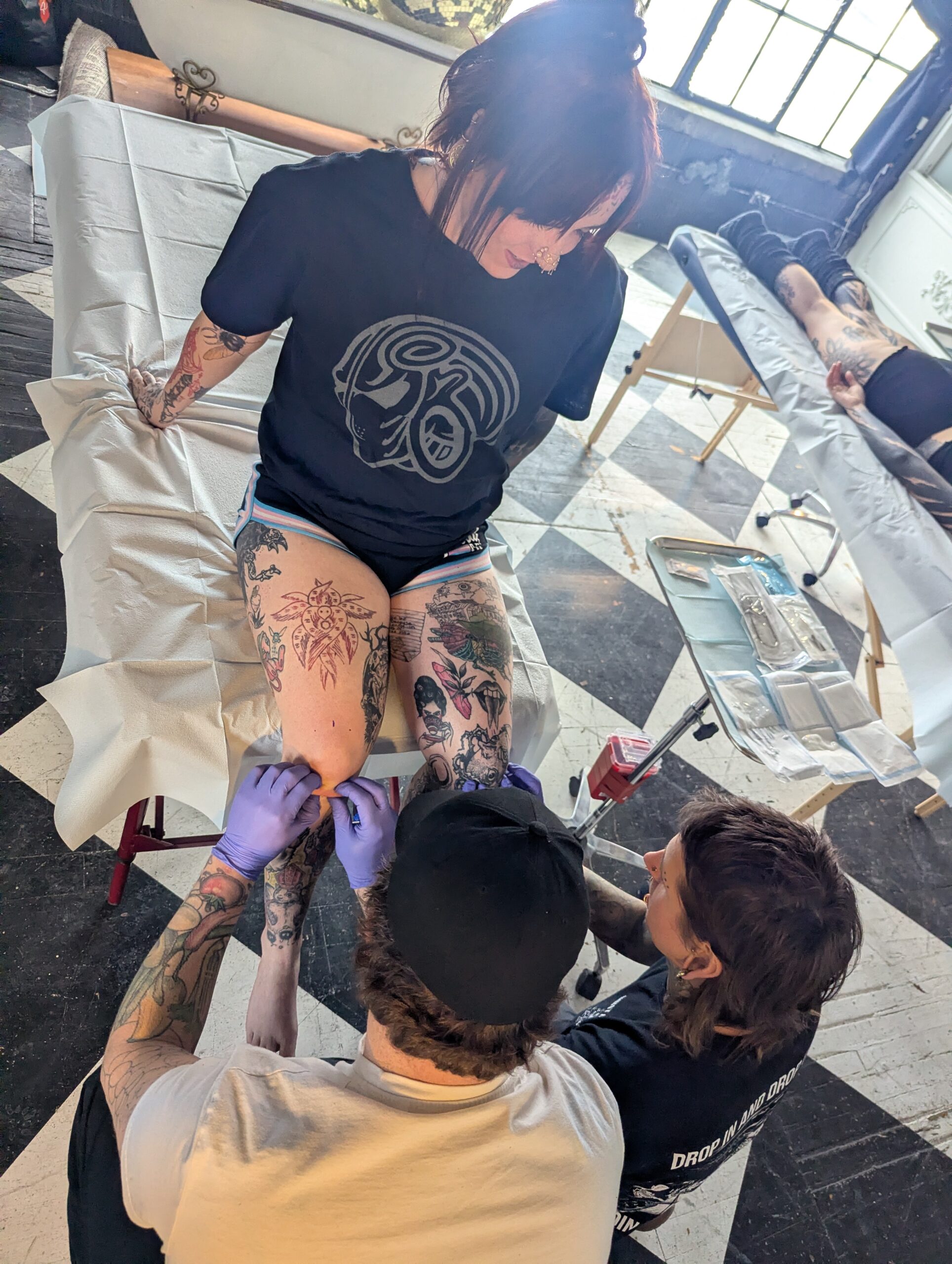
Just before the first needle marks the skin, an observer asks Maddie if she minds being watched; the woman explains she is considering a knee suspension later that year. Maddie readily agrees, an immediate extension of the hospitality that defines the space. Despite the heavy music, Norman moves with a buoyant, contagious energy. He recognizes the massive significance of these practices, and his joyful commitment to making sure everyone is cared for at every step puts the room at ease.
"It’s a privilege to be able to be part of that," explains Mel, a member of the collective. "It makes for very fast friends just because you have to have that instant level of trust with each other." This trust is the infrastructure of the room. As Chris Wedemire notes, the person on the hooks can trust the crew because the crew trusts each other so deeply: "They have an inherent trust in us just because of how much we trust each other."
A Political Body
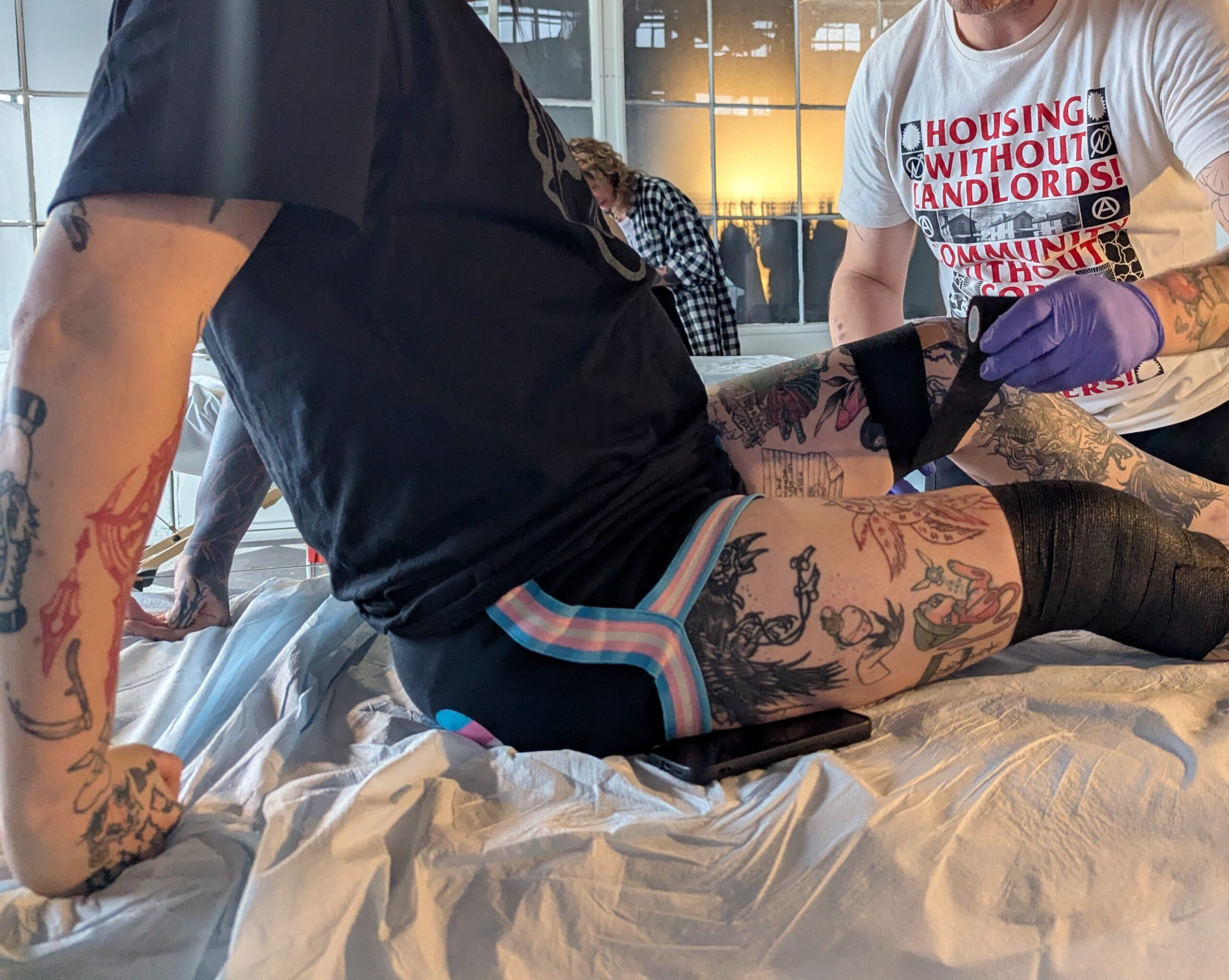
The OSC space is defined by an abolitionist aesthetic. Many members wear shirts with slogans like "Housing Without Landlords" or "Love Suspension, Hate Fascism." For this group, the act of suspension is a way to reclaim total ownership of the body, asserting a level of autonomy that exists outside of institutional control.
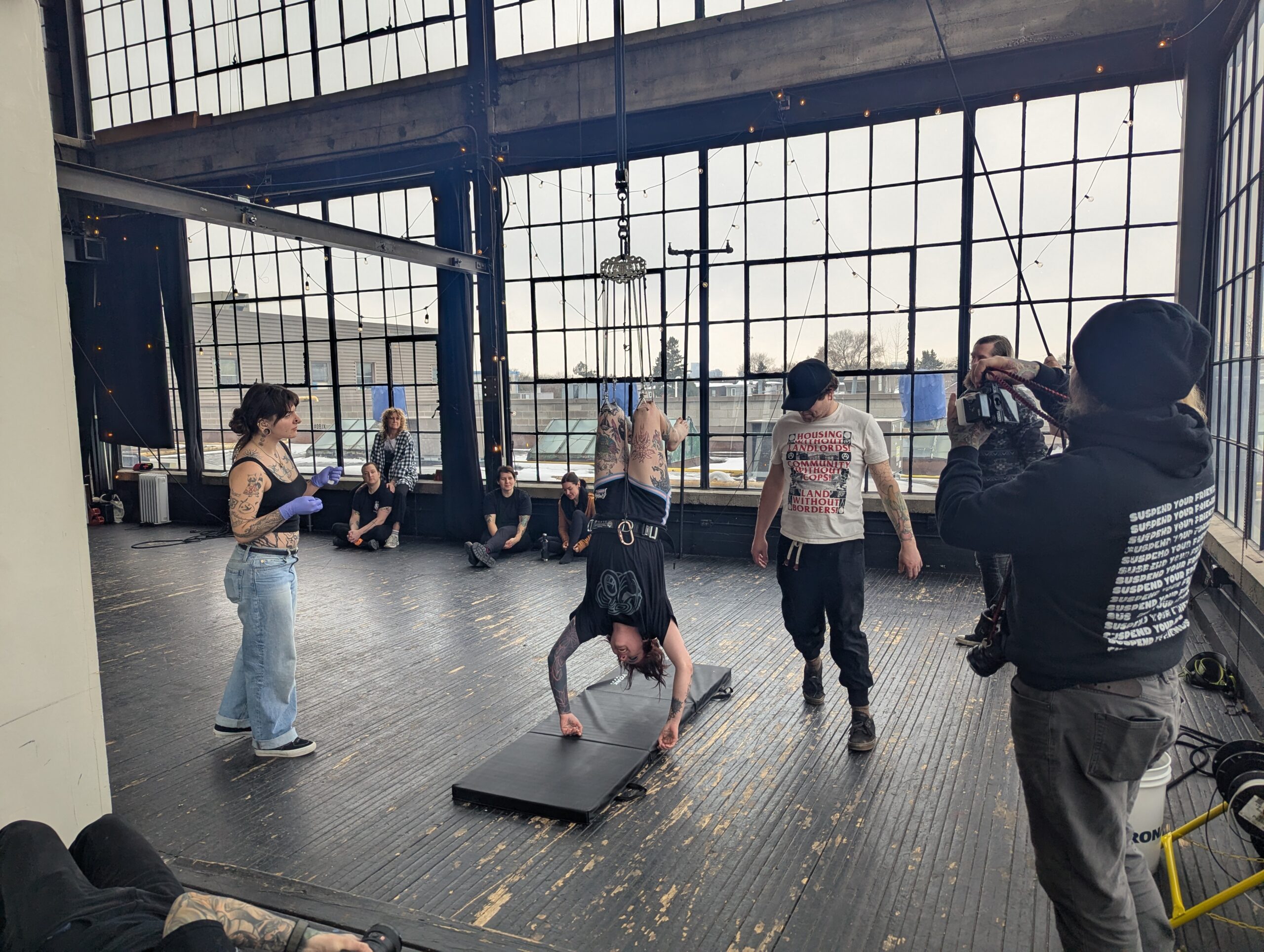
"To be involved in a suspension community is kind of…already a political act in itself," says Chris. "It’s an act of self-realization that strays from the status quo." Maddie views the body as a final frontier of resistance: "In this space, the body is the only thing the state hasn't fully mapped yet."
This autonomy extends to the reclamation of culture. Mel, whose mother is Indigenous, sees suspension as an interpretive bridge to rituals like the Sundance. The Canadian government criminalized the Sundance and other Indigenous ceremonies under the Indian Act in 1885, a ban that remained in place for nearly 70 years until 1951. "It feels political in a way," Mel says, reclaiming the practice of processing emotions through physical endurance.
The Shift: From Panic to Peace
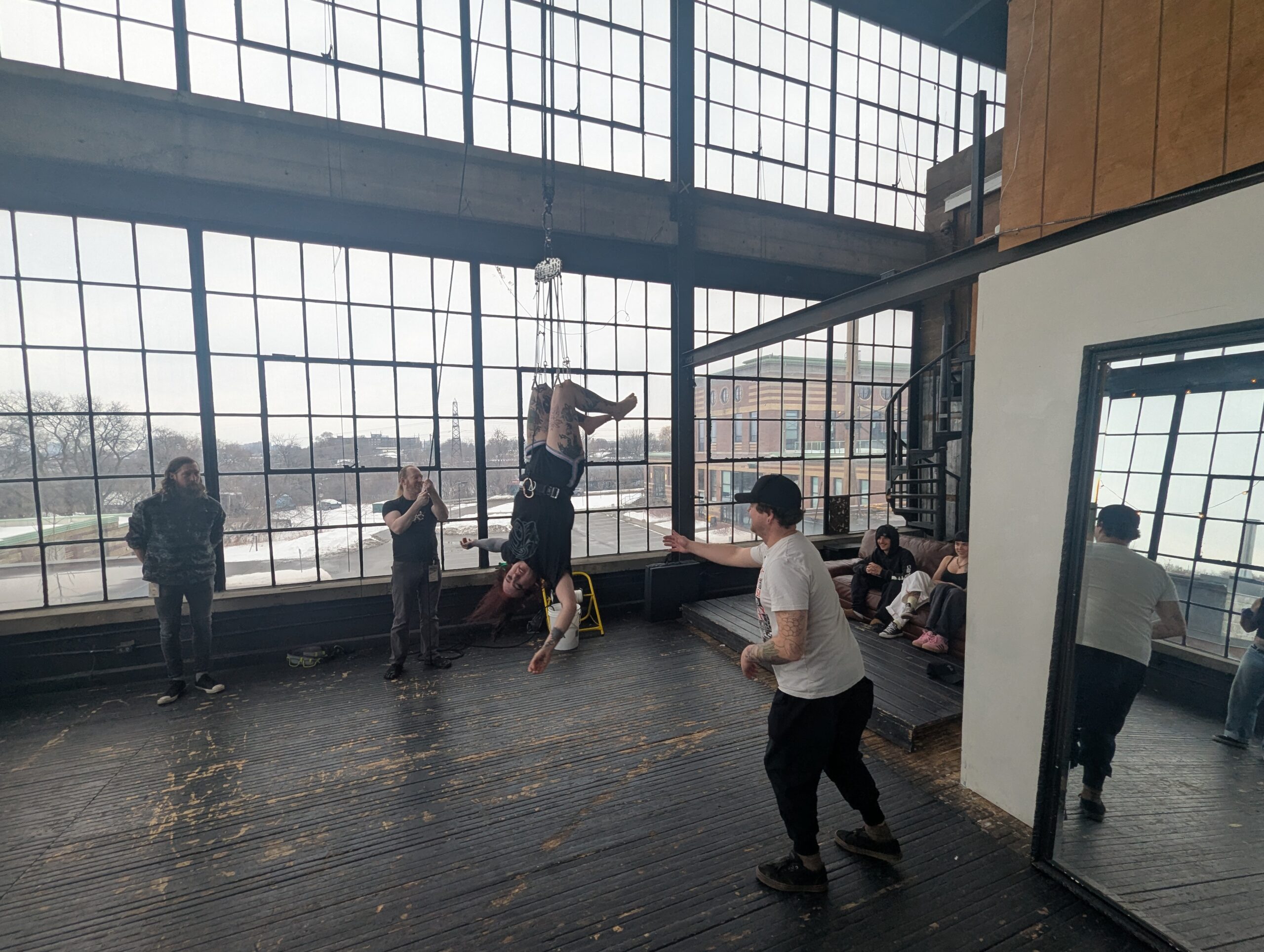
When the slack finally leaves the rope and Maddie’s entire body weight is taken by her knees, the room remains quiet, but the air is filled with a sense of collective pride. Suspension often triggers a primal "panic response"—a mental battle where the mind screams at the body to stop.
"You’re kind of having a mental battle with yourself, pushing yourself and then freaking out a little bit," Maddie explains. "And then the endorphins just really kick in. It’s like this grounding point while you're floating in euphoria."
Chris, holding the belay rope, feels every second of this transition. "When you're holding that rope, if somebody laughs and somebody shudders, you can feel that," he says. It is a "direct line of energy" that requires total mindfulness from the crew to ensure the flyer "settles" into their flight.
Radical Care
The strength of the collective is most visible not in the height of the flight, but in the depth of the care. When one practitioner experienced a physical reaction after a long suspension, the OSC's expertise was immediate and calm. Rather than panic, the team moved in unison—holding her hair, cleaning the space, and providing a grounded presence—proving they are as skilled in aftercare as they are in the suspension itself.
In this warehouse, success isn't measured solely by time in the air. The ritual is about showing up and contributing to the energy of the room. "It’s not about just getting up off the ground," says Aly Dols, who found suspension during her recovery from addiction and self-harm. Some people decide they don't want to suspend after being pierced, and that is still viewed as a victory. "You know what they did? Because they got there. They got on that table. They got pierced."
The Reclamation: Maddie’s Journey
After 30 minutes, Maddie is lowered. The team moves in with immense care, as technical and gentle as a nurse, to remove the hooks and meticulously bandage her knees.
For Maddie, this practice is a "grounding ritual" that she seeks out every few months to reorient herself. Living with a Chiari malformation—where her brain tissue extends into her spinal canal—she deals with chronic pain every day. Suspension isn't about escaping that pain, but about choosing it on her own terms.
"It’s about taking my body back," she says, explaining that the intensity of the hooks teaches her how to live with the pain she cannot control. "As much as it takes me away from the earth, it brings me back to it." As she walks across the checkered floor, bandaged and grounded, the metal music continues to roar, but the internal calm remains. "Do it," she says of the mental battle. "But do it scared."
Originally published in The Sarnia Journal.
