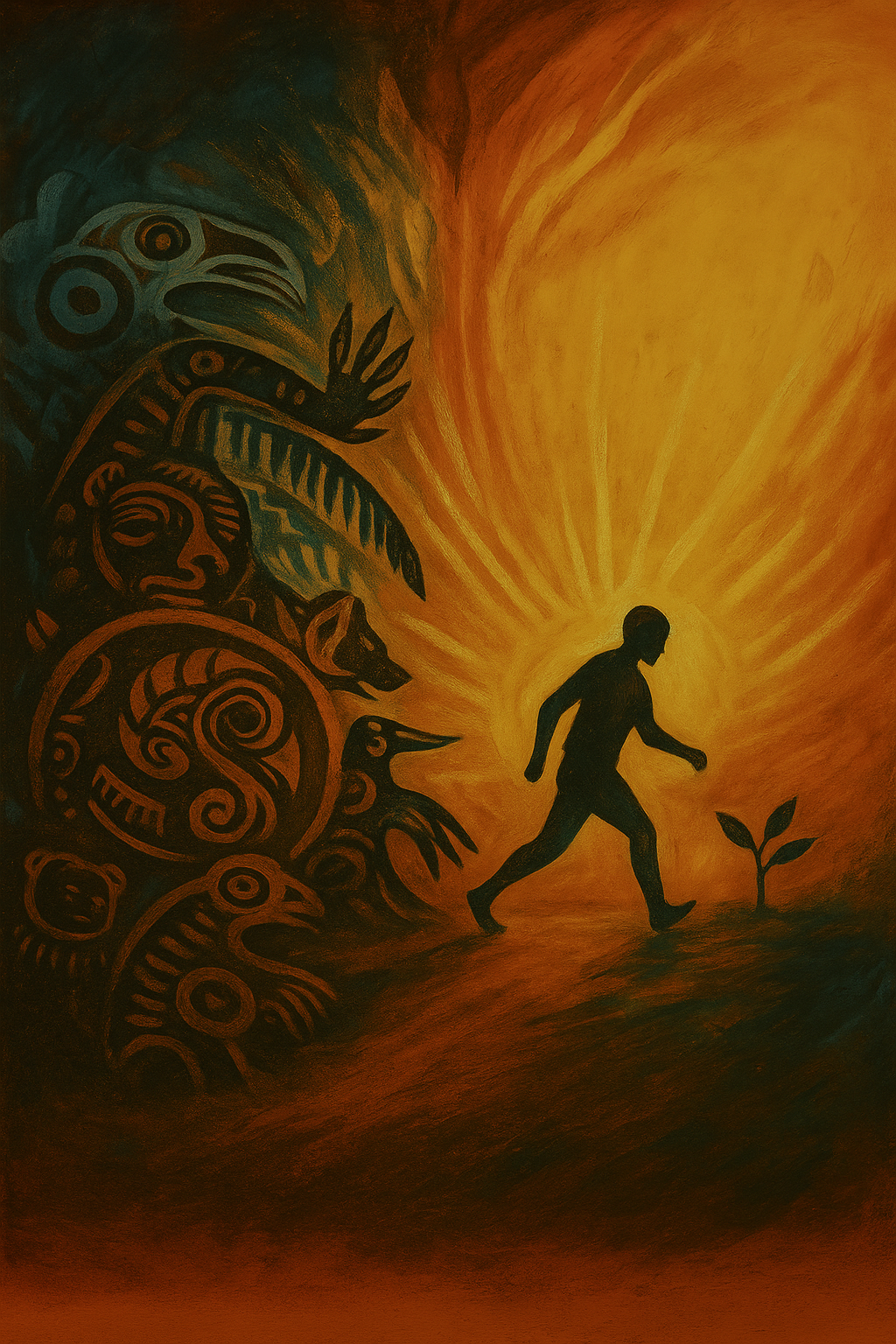
THE END OF WORK,
THE START OF US
How AI Proved Work Was Always Fucked—and
What We Can Build Instead
Nathan Colquhoun
Copyright © 2025 by Nathan Colquhoun
All Rights Reserved. Except as permitted under the U.S. Copyright Act of 1976, no part of this publication may be reproduced, distributed, or transmitted in any form or by any means, or stored in a database or retrieval system, without the prior written permission of the publisher.
Any unauthorized copying, translation, duplication, importation, or distribution, in whole or in part, by any means, including electronic copying, storage, or transmission, is a violation of applicable laws.
Preface
I grew up in Sarnia, Ontario, a quiet industrial town where the air often smells like chemicals and the only dream is early retirement. Twenty years ago, I started essays called The Sarnia Mindset. They were raw and clumsy, but honest. I was trying to name the deep boredom and quiet resignation I saw everywhere. People didn’t talk about it, but it showed up in how we worked, shopped, and stopped caring. I was angry. I still am. Two decades later, not much has changed. If anything, it’s worse. And now AI is accelerating everything we failed to question.
I’ve spent my adult life trying to build something different. I’ve co-founded businesses like restaurants, breweries, and a design studio— not because I wanted to be an entrepreneur, but because it was the only way to make life bearable. I’ve tried living in community. I’ve run for political office. I recently bought a small newspaper, turning it into a cooperative media platform that doesn’t flinch when things get hard. I still believe in local stories. I still believe in people.
This book is the clearest version of what I’ve been trying to say: we were never made for this. Work was never meant to own us. The future doesn’t have to be more efficient; it has to be more human. I wrote it alongside the people I love. To Javi, who lives this chaotic life with me. To my boy, Sol, who teaches me daily what vigilance and honesty look like. To Joe, my co-conspirator of two decades. To Dan, who keeps dragging my thinking closer to justice. To Detroit, for showing me that beauty grows from rubble and to Baxter beach for grounding me.
This book is for anyone who has felt the weight of pretending this is fine. It’s not. And we don’t have to play along anymore.
Contents
Chapter 1: The Bullshit We Called Work
Chapter 2: The Algorithm Is the Messenger
Chapter 3: Creativity Is a Commons
Chapter 5: Work Was a Religion
Chapter 6: The Curriculum of Control
Chapter 7: The Crisis of Value
Chapter 8: The Care Underground
Chapter 10: The Bridge to Basic
Chapter 11: The Climate of Collapse
Chapter 12: The City That Knew the Future
Chapter 13: A World Without Police
Chapter 14: The Inner Algorithm
Chapter 1 — The Bullshit We Called Work
What AI is exposing, our bodies already knew.
My friends who worked in Chemical Valley, they had a turn of phrase. It wasn’t about salary, not really. It was about shifts. Night shift, weekend shift, swing shift, whatever paid the most and demanded the least. They’d brag about it, compare schedules like sports stats. One guy got through a whole Netflix series during a single twelve-hour stretch. Another had a system for sleeping in the control room without missing alarms. For someone unaccustomed to this rhythm, this might seem a peculiar way to measure a life, or even a job.
It wasn’t about loving the job. That was never the point.
The win was figuring out how little of yourself you had to give in exchange for a steady cheque and enough cash to fill a garage with toys you barely had time to use, or maybe just buy a bit of quiet from the bills. Everyone knew how to make the system work for them. It was about minimizing how much of yourself you had to give away to get the cheque.
At first, I felt a pang of jealousy. All that money, seemingly for doing nothing, all that free time to watch movies. But then a confusion settled in. What was the real value of their job? Was it just the money, and the permission to watch movies while on the clock? Why lie on a cot, or try to hack the system, just to survive and pay the bills, giving up forty hours a week sitting in dirty offices in the middle of the petrochemical industry? For someone with different social norms, the sheer intensity of this trade-off, time for a cheque, might seem baffling.
It felt smart, efficient, at first. Then, strange. This quiet rebellion, this “shiftwork flex,” an early form of “quiet quitting,” was a subtle withdrawal of enthusiasm, of effort, from jobs that demanded too much for too little. It was a way of saying, without saying it, that the emperor had no clothes.
The very foundation of these work cultures often rests on what the late Mark Fisher termed ‘capitalist realism’—this pervasive sense that our current way of working, however flawed, is the only way things can be, making it easier to imagine the end of the world than true systemic change in how we work.
David Graeber’s enduring analysis of “bullshit jobs” laid it out plainly: we’ve built entire economies around jobs that don’t need to exist. His five types of bullshit jobs resonate even more powerfully in the age of AI, which doesn’t just automate tasks but illuminates the inherent pointlessness of many roles we’ve created:
Flunkies: There to make someone else feel important. Goons: Hired muscle for someone else’s agenda. Duct Tapers: Fixing problems that shouldn’t exist. Box Tickers: Creating the illusion that something is happening. Taskmasters: Assigning or managing work that doesn’t matter.
Recent quantitative studies, like those by sociologist Simon Walo of the University of Zurich, have validated Graeber’s theory, finding that a significant portion of employees, especially in business, finance, sales, and administrative roles, perceive their work as socially useless.
These are jobs AI isn’t just taking over; they reveal themselves as already hollow.
The Deeper Deception: AI Exposes “Efficient Inefficiency”
The advent of AI isn’t simply about machines doing tasks faster; it’s about exposing the efficient inefficiency at the heart of our work systems. As researchers Stuart Mills and David A. Spencer explain, if AI is applied to “bullshit tasks,” it doesn’t create new efficiency; it merely speeds up inefficiency.
We’re not automating productive labor; we’re automating the pretense of labor. AI can help organizations churn out more useless reports, optimize pointless meetings, or manage redundant workflows at an unprecedented pace.
The problem isn’t AI, but the systemic waste it now amplifies.
This goes beyond simple automation. The real shock is that AI can often perform these “bullshit tasks” as well as, or even better than, humans, because these roles were designed for compliance and predictable output rather than genuine value creation.
We built roles where the ideal employee was a machine: meticulous, uncomplaining, devoid of original thought. When the actual machines arrived, they simply stepped into roles already rehearsed for them.
I used to make fun of my pastor friends for giving the same wedding sermon at every ceremony. Just swap the names, keep the Bible verses, recycle the stories. It was sacred copy-paste. At the time, it felt lazy. Now it feels like most jobs I’ve ever seen. Fill out the form. Say the words. Sound like you care. When AI starts doing that work better than us, it’s not the end of humanity—it’s a punchline. That was ministry. Or strategy. Or user experience. But mostly, we were just performing sincerity in a script we didn’t write.
As venture capitalist Victor Lazarte bluntly puts it, the idea that AI is only augmenting human jobs is “bullshit”; it’s fully replacing them, especially in fields like law and recruitment, precisely because much of the work involved was repetitive and rule-based.
The Illusion of Purpose
For generations, work has been our primary source of identity, community, and economic survival. We internalize the lie that all work is inherently valuable, that busyness equates to purpose.
But AI cracks this illusion wide open. When an algorithm can mimic your “creativity” or “strategic thinking” in seconds, it forces a reckoning: was that truly meaningful work, or just a performance we’d all agreed to?
The system didn’t collapse because AI entered the room. It collapsed because the performance of work had already replaced the reality of it.
There’s an old argument inside socialist thought that’s worth dragging into this mess: Is technology here to free us, or to finish the job of control? Early communists thought machines might liberate workers from repetition, from exhaustion, from having to trade life for survival. But it didn’t take long for others to notice the machines weren’t killing capitalism. They were making it more efficient. Soviet factories still burned people out. Western ones just learned to smile while doing it. AI fits right into this fight. It’s marketed as liberation: freedom from admin, from inboxes, from “low-value tasks.” But most of what it’s doing right now is making labor cheaper, more watched, and easier to replace. The algorithm isn’t neutral. It’s a tool shaped by the same systems it claims to disrupt.
The truth is, AI highlights the profound disconnection many people already feel: the sense that their effort is misplaced, their time wasted, their potential squandered on tasks that add no real value. This silent suffering, often dismissed as mere “burnout” or individual failure, is in fact a systemic issue that AI’s capabilities make impossible to ignore. This quiet desperation fuels movements like /antiwork on Reddit, where millions openly question the very premise of modern labor. For someone from a background where work, even if challenging, had a more direct or tangible connection to survival or community, this obsession with performative work might seem like a peculiar kind of collective neurosis.
What People Actually Fear
Most people aren’t afraid of being exposed as meaningless. They already knew.
What they’re afraid of is losing the only structure that let them survive: The mortgage. The groceries. The rhythm of the week.
This is a crisis of stability, not self-worth.
We’ve built a society where the only guaranteed way to stay afloat is to attach yourself to work, whether or not that work matters. When AI threatens that attachment, it doesn’t feel like innovation. It feels like betrayal. For someone from a society where community bonds might offer a stronger safety net, this singular reliance on formal employment might seem incredibly fragile.
Alienation doesn’t just strip meaning. It makes survival conditional on performance.
The Scaffolding Is Coming Down
We’ve surrounded meaningless jobs with layers of meaning-signaling: mission statements, performance reviews, company retreats, HR trainings.
That scaffolding is shaking.
AI is just speeding up a process that was already underway. Not because it wants to. Because the foundation was hollow.
Systems don’t collapse when something new is added. They collapse when they can no longer pretend.
The Algorithm Is the Messenger
That’s where the backlash comes from. Not the code. The exposure.
People aren’t terrified that machines are getting smarter. They’re terrified that the machines are repeating back what we’ve already been saying to ourselves.
The algorithm didn’t steal the story. It simply read the script out loud.
Chapter 2 —
The Algorithm Is the Messenger
The machines aren’t getting smarter. We’re getting honest.
The First Freakout
A guy uses ChatGPT to write a wedding speech. It makes everyone cry.
A teenager turns in an essay written entirely by AI. The teacher gives it an A.
Nobody is mad because it was bad. They’re mad because it worked.
The freakout isn’t about cheating. It’s about realizing how thin the whole system already was. If the machine can do it in seconds, what were we spending hours doing? For someone encountering this for the first time, the sheer intensity of the reaction, not to the AI’s capability but to the perceived lack of human value, might be a jarring revelation.
We didn’t think the machine would be good at this. Now we’re wondering why we needed to be. The system was already primed for this kind of automated output, because it valued conformity and measurable performance over genuine human input.
AI Isn’t Brilliant. It’s Just Trained
Ted Chiang called it a “blurry JPEG of the web.” AI doesn’t invent. It reflects. Sometimes beautifully. Sometimes grotesquely. Always quickly.
We thought originality would protect us. That our art, our flair, our voice, these things made us irreplaceable.
Turns out the machine learned to play our role. The role was already rehearsed. The unsettling truth isn’t AI’s genius, but its uncanny ability to mimic the very patterns of thought and expression we’ve been conditioned to produce. It’s a mirror reflecting our own conformity, not its inherent brilliance. For someone from a culture where art and expression might be more communal or less commodified, the idea of “originality” as a shield against automation might seem like a particularly Western anxiety.
The Mural in the Park
There was a mural contest at a park in Sarnia. Community event. Nice thing. One of the top finalists was an AI submission.
Immediate outrage: “This is theft.” “This isn’t art.”
But the real fear wasn’t plagiarism. It was proximity. The AI submission looked good enough. And that stung. I would’ve paid the $500 prize myself just to avoid hearing the comments section reenacted in real life. The panic wasn’t about the rules. It was about the ritual. Community art is one of the few places we still pretend to know what counts as human.
When the machine gets shortlisted, it doesn’t just violate the rules. It violates the comfort. The outrage was less about the art, and more about the disruption of what was considered proper, what was acceptable.
The Backlash Is a Grief Response
We talk like this is a tech war. It’s not. It’s grief.
The Luddites weren’t technophobes. They were dignity defenders. They didn’t hate machines. They hated being treated like them.
What people feel when AI wins the contest or passes the test isn’t fear. It’s mourning. Not because the machine is soulless. But because the task was.
We’re grieving the exposure of a truth we’ve long suppressed: that much of our “meaningful” work was already devoid of soul, and AI simply made that undeniable.
Industry Trained Us to Be Replaceable
AI didn’t kill originality. Work did.
Years before ChatGPT, we were already turning ourselves into content pipelines. Resume buzzwords. LinkedIn humblebrags. Instagram captions calibrated to catch engagement.
Every time we formatted ourselves to be legible to a system, we taught that system how to copy us. Capitalism didn’t just want our labour. It wanted our formatting. It wanted us to be easy to process.
This drive for standardized output, often enforced through metrics and performance reviews, has inadvertently created the perfect training data for AI. As Cory Doctorow often warns, platforms and systems designed for control inevitably lead to the “enshittification” of content and human expression, flattening unique voices into predictable, automatable patterns.
Platforms Taught Us to Sound the Same
TikTok taught us to open videos with the same seven-second hook. Spotify taught us to write songs the algorithm could surface. Google taught us to write like answers.
We were training the machine every time we optimized our creativity. We were never taught to be original. We were taught to be consistent.
The machine didn’t beat us. It simply outperformed our performance. It simply took the script we were already rehearsing and delivered it with perfect, unfeeling efficiency.
Deepfakes, Auto-Driven Everything
The new music from your favorite artist? Mostly prompts. The next customer service call? A script inside a chatbot. The deepfake politician? Still polling better than the real one.
It’s not that the fake sounds real. It’s that the real was already running on autopilot. We’ve been so accustomed to curated, optimized, and often inauthentic interactions that the distinction between human and machine output has blurred, making AI’s intrusion less a shock and more a logical conclusion. For someone from a less mediated society, this constant blurring of lines between authentic and artificial might feel profoundly disorienting.
Humans Still Hurt, Even If the Output Doesn’t
An AI can write a breakup song. But it’s never been dumped. It can write a eulogy. But it’s never sat in the front row at a funeral.
The danger isn’t that the AI lacks feelings. It’s that we’ve stopped asking who does.
This is the line that matters. Not because it proves our worth, but because it reminds us what we’ve been trying not to feel, the raw, unquantifiable, and deeply human experience of pain, joy, and presence that no algorithm can replicate.
Don’t Blame the Tool for Telling the Truth
If the machine can do your job, the problem isn’t the machine. The problem is that the job was that machine-like to begin with.
AI didn’t kill your craft. It simply showed you the script. And you recognized it.
The discomfort is legitimate. But the direction of blame is often misplaced. The system that demanded you sound like a machine, that commodified your unique voice into predictable output, is the real culprit.
AI is merely the messenger, holding up a mirror to the performance we’ve all been trapped in.
The Unowned Voice
This isn’t the death of creativity. It’s the death of ownership.The machine didn’t steal your voice. It simply learned to copy the one you were already rehearsing.
If it can be mimicked, maybe it was never yours alone. And maybe that’s exactly what makes it worth reclaiming.
Chapter 3 —
Creativity Is a Commons
Copyright is dead. Creativity just learned to breathe.
Stolen Creativity Isn’t New
It starts like this: someone posts a drawing on Tumblr. It’s raw. Personal. Maybe a little weird. It gets a few hundred shares. Maybe someone tattoos it on their ribs. A week later, it shows up on a Forever 21 knockoff t-shirt with some corporate catchphrase slapped on top. No credit. No message back. Just profit.
They’re not mad because it got shared. They’re mad because someone else made money from it.
Theft isn’t new. Neither is remixing. That’s what creativity is.
But this wasn’t remixing. It was extraction; something personal turned into profit, without care or consent. The problem was never sharing. The problem was watching something you made with care get lifted, stripped of context, and sold back to people who didn’t know where it came from.
It’s happening faster now, with AI. Faster and harder to name. A poem fed into a dataset. A photo scraped without consent. A voice cloned and sold.
But the pattern isn’t new. It’s just more efficient now.
The focus here isn’t AI threatening creativity, but how creativity was already under threat. AI might just expose who was doing the stealing all along: not machines, but the systems that commodified our culture long before the first dataset was scraped.
There’s an old line from Proudhon that gets thrown around like a slogan: “Property is theft.” And it is when we’re talking about the kind of property that lets you profit from other people’s work. But that’s not the same as someone’s tools, or their home, or the beat-up notebook they write songs in. What Proudhon meant, and what gets lost when the phrase goes TikTok-viral, is that the problem isn’t owning things. It’s owning what others need to survive, and then charging rent. That’s what copyright turned into. That’s what AI models do when they’re trained on other people’s work without consent. If the rich start using “property is theft” to justify stealing your sketchbook, that’s not revolution. That’s theft again just with better branding.
There’s a German philosopher named Heidegger who said modern tech doesn’t just use the world, it reorganizes how we see it. He called it “enframing.” The idea is this: everything starts to look like a resource. Trees aren’t trees—they’re lumber. Rivers aren’t rivers— they’re hydro. Feelings aren’t feelings—they’re data points. AI is that logic on steroids. It doesn’t just scrape content. It reshapes how we think about ourselves; like we’re just inputs waiting to be optimized. Your jokes, your heartbreak, your childhood memories are all fed in, sorted and flattened. Not for connection. For prediction. For profit. This isn’t just about copyright. It’s about how even our aliveness is being turned into inventory.
Capitalism didn’t just steal art. It stole context, community, and credit, and sold them back to us as product. The problem was never sharing. The problem was control.
And let’s not pretend the commons is safe just because copyright is dead. The people building AI didn’t do it for us. They did it for scale. For profit. They scraped the internet: our drawings, our poems, our accents, our slang and fed it to a machine built to generate product. Not community. Not connection. Product. It’s not the birth of a new commons. It’s a new enclosure. Another round of cultural extraction, this time faster and with fewer fingerprints. If anything, AI shows how capitalism doesn’t need your permission to keep taking. It just needs your content.
The Myth of Genius Is a Corporate Invention
Brian Eno calls it “scenius”: the shared intelligence of a scene. It’s what happens when ideas pass between hands, pick up scars, and get sung back louder. It’s a basement jam session. A group chat full of inside jokes. A basketball court where someone coins a phrase that makes it into a Drake song five years later.
But capitalism doesn’t like groups. It likes stars. A single face on the poster. A signature on the contract. Someone you can quote in a press release. So it sells you the myth of the lone genius. The visionary. The exceptional one. It tells you that if you were really talented, you’d stand out. You’d get picked.
Meanwhile, culture is being built in youth group skits, late-night freestyles, and aunties making up lullabies that never get recorded. None of it is copyrighted. None of it goes viral. But it feeds us. For someone from a culture where art and expression might be more communal or less commodified, the idea of “originality” as a shield against automation might seem like a particularly Western anxiety.
I once wore a tank top and straw fedora to a Sarnia city council meeting. It wasn’t casual. It was a protest against a proposed dress code that claimed respect was something you could iron out. I was a sitting councillor. The motion failed. But the outfit got national headlines. Newspapers, radio, social media firestorms. Nobody wanted to talk about the waterfront plan or active transportation. They wanted to talk about my shoulders. That moment said more about creativity than any arts policy I’ve seen. I used humour, interruption, and plain disobedience to challenge who gets to look like they belong in power. And I watched the system try to turn the whole thing into a spectacle about style instead of substance. I remember an old lady even called me and left a voicemail about how dare I expose my “stinky armpits” to the councillor next to me during the whole spectacle. The outrage was less about the art, and more about the disruption of what was considered proper, what was acceptable.
The system tried to reframe an act of creative dissent into a simple issue of decorum, proving how threatened it is by any creativity it can’t control or commodify. That’s how this works. That’s how it’s always worked.
If You Had to Ask Permission, It Wasn’t a Commons
I used to think creativity belonged to people who got degrees in it. Or who moved to big cities and submitted to galleries.
But I grew up watching raw, vibrant street art disappear from walls, only to see its aesthetic sanitized and sold on mainstream clothing lines a year later. I watched teenagers make memes that shaped the whole vibe of a school. I saw friends remix protest chants into worship songs into comedy bits into real conversations. None of it came with a grant. None of it got written about.
That was the commons. We just didn’t have a name for it.
If you had to ask permission to make something, it probably wasn’t the real thing. The system told us: unless you can sell it, it doesn’t count. For someone from a society where artistic expression might be more integrated into daily life and less driven by market forces, this transactional view of creativity could be deeply alienating.
Now AI breaks that open. Anyone can write. Remix. Build. Record. Not because they’re better, but because no one’s checking their credentials anymore. This democratization, while unsettling to those who profited from scarcity, forces a re-evaluation of where true creative value lies.
Creativity as Hustle Is a Dead End
Instagram turned artists into content farms. TikTok turned dancers into brand strategists. YouTube turned sketch comedy into SEO marketing. Creatives got rebranded as “creators,” then monetized into oblivion.
What we used to call art became content. What we used to call joy became “engagement.” You weren’t drawing because you loved it. You were drawing because the algorithm liked pink and you hadn’t posted in three days.
It killed play. It killed experimentation. It turned creativity into branding.
So if AI threatens that economy? Good. If it makes influencer marketing collapse? Good.
Maybe now we can stop performing for clicks and start creating for each other again. This disruption, while painful for some, offers a radical opportunity to reclaim creativity from the demands of the market.
The App That Captured Nothing
I was once involved in a project to build an app for a government agency in Ontario, designed to collect immigrant stories. The concept itself felt dehumanizing from the start, despite the contract being filled with beautiful words about stories, memory, and representation.
So I designed it: interviews, prompts, data flows, dropdown menus so people could “easily” select which themes they were addressing. And then, nothing. No one used it. No stories were collected. Just a clean interface and a dead Google Drive folder.
The problem wasn’t the tool. The problem was the underlying belief that real human lives should be formatted for easier consumption. We treated people’s experiences like raw data we could mine for insights, instead of honoring them as complex, living things. For someone from a culture that values oral tradition or personal narrative over data points, this approach might seem particularly cold or disrespectful.
We didn’t need a cleaner design. We needed someone to listen. This project, while a job I was working on, became a stark example of how even well-intentioned efforts can be corrupted by the drive for quantifiable output and legible data, missing the true, messy essence of human experience.
Who Gets to Be Creative?
Talk about class: how creative labor has always been stratified. Working-class people made music, stories, art, but weren’t called “artists.” Middle-class kids get MacBooks and internships. Everyone else gets called a “hobbyist” or “side hustle.”
This class divide, often intersecting with racial and gender disparities, meant that access to “legitimate” creative avenues was never truly equal. AI levels the playing field, but only if we stop pretending creativity lives in credentials.
If the gatekeepers of traditional art and publishing are disrupted, it creates space for voices previously excluded to emerge.
Neurodivergence, AI, and the New Tools of Co-Creation
Neurodivergent creators use AI for structure and scaffolding, turning internal chaos into external order. People with limited time use it to start ideas they finish themselves, overcoming initial creative blocks.
It’s not replacing creativity. It’s revealing who was excluded from it in the first place, offering new tools for access and expression to those for whom traditional creative processes were barriers. This isn’t about AI replacing human ingenuity, but about it serving as an assistive technology that expands the circle of who can participate in creative acts.
Copyright Is Dead. And That Might Be Fine.
Call out the absurdity of modern copyright: It protects corporations, not people. It stifles access more than it protects originality.
Brian Eno again: “Stop thinking about ‘copyright’ and start thinking about ‘copywrong.’”
Creativity shouldn’t be locked up to prove its value. The current copyright system, designed for a scarcity model of creation and distribution, is increasingly irrelevant in an age of infinite digital copying and remixing. AI, by making replication effortless, forces a necessary reckoning with this outdated paradigm.
If the Machine Can Remix It, Maybe It Wasn’t Sacred
This isn’t cynical; it’s freeing. If AI can produce something passable, maybe the soul wasn’t in the product. The soul was in the intention, the presence, the making.
“The machine can finish your sentence. But it can’t remember why you started talking.”
This insight liberates us from the false idol of the “perfect output” and redirects our attention to the human process, the messy, relational act of creation itself. It’s a call to find meaning not in the polished artifact, but in the vulnerability and presence of its making.
Outsourcing the Sacred
Creativity is no longer sacred because we outsourced the sacred. In the following section, we meet the new gods: the predictive systems we now trust more than each other.
If copyright is dead, it’s because the thing we tried to protect was never supposed to be owned.
Chapter 4 — God Made of Code
AI, certainty, and our new priesthood of prediction.
We used to ask our friends for advice. Now we ask ChatGPT. Not always. Not for everything. But enough to notice.
I know a couple who used it to write their breakup text. A mom who used it to write her daughter’s birthday card. A college student who asked it for a five-year life plan.
People go to AI with questions they once asked a friend, a partner, or a journal. We’re not just asking it to help us think. We’re asking it to guide us. For someone from a culture that values collective wisdom or spiritual guidance from elders, this shift to an algorithm might seem profoundly isolating or even a form of technological idolatry.
That shift matters. Not because it’s scary, but because it’s revealing. We didn’t suddenly become spiritual seekers looking for a higher power. Most people I know aren’t chasing metaphysics. They’re trying to make it through the week.
But in a world that’s exhausted our trust in each other, in experts, institutions, even families, something that sounds sure of itself starts to look like salvation.
We didn’t ask for a new god. But we built one anyway.
The Interface Isn’t Neutral
There’s a reason people trust AI that has nothing to do with intelligence. It never flinches. It doesn’t pause or hedge or stammer. You ask it a question, and it answers. Calmly. Cleanly. Confidently.
That’s not knowledge. That’s formatting.
McLuhan was right. The medium shapes the message. The design of the interface, the blank white box, the polite tone, the perfectly spaced paragraphs, makes it feel like truth. Like it knows something we don’t.
And in a culture that equates polish with professionalism, fluency with insight, it’s easy to confuse clarity for wisdom. But all we’re really seeing is a machine that knows how to sound certain. And right now, certainty is in short supply.
When Help Becomes Dependence
At first, it was a novelty. We asked AI to write poems about our dogs. Then we asked it to help with emails. Now it’s handling our grief, our resumes, our wedding vows.
I’m not saying that’s wrong. I’m saying it’s fast. What used to be a conversation with a friend, a therapist, a mentor, or even a notebook has become a prompt and a reply.
It didn’t replace thinking. It replaced uncertainty. That’s the real draw. Not that it’s too smart. But that it’s never unsure.
In a time when most of us are tired, distracted, and unsure of everything, our careers, our relationships, our sense of direction, AI feels like a way out. It doesn’t interrupt. It doesn’t misunderstand. It just tells you what to do.
Until you stop asking anyone else.
The Rise of the New Priest Class
We don’t have to call it religion for it to function like one. Look at how we treat the people who build these systems: Altman, Musk, Pichai. They’re not just seen as engineers. They’re treated like prophets.
They talk about AI the way theologians talk about God, with words like “alignment,” “existential risk,” and “saving humanity.” The way they speak, you’d think they were keeping Pandora’s box shut for our sake. Or opening it on our behalf.
But this isn’t about belief. It’s about power. The public didn’t elect these people. We didn’t vote for this future. But we’re being asked to obey it anyway. For someone from a society with different power dynamics, the sheer scale of this unelected authority might be particularly alarming.
And because the engineers speak with confidence, and the tools speak with fluency, we listen. It’s not divinity. It’s design. This new priesthood, predominantly white and male, mirrors historical power structures, subtly reinforcing existing inequalities even as it promises universal solutions.
The System Is Built to Be Obeyed
We don’t worship intelligence. We worship confidence. And AI is confidence distilled. It never blinks. Never doubts. Never says “I don’t know.” That’s what makes it seductive. Not its depth, but its delivery. It gives you the answer. It doesn’t question your question. It doesn’t reflect your hesitation. It just goes.
And for a lot of us, that’s what we secretly want. Not partnership. Not nuance. Just permission to stop guessing. We want to feel sure again. About our work. About our future. About what to say and how to act.
But in a culture built on speed and performance, the only way to get there is to outsource our uncertainty. And now we can.
What Indigenous Knowledge Already Understood
There are wisdom traditions that never separated knowing from relationship. Robin Wall Kimmerer writes about knowledge that is “given through the grasses,” not extracted from them. Tyson Yunkaporta calls it kinship systems of understanding, where every answer belongs to a web of story and reciprocity.
In those worlds, knowledge isn’t a download. It’s a conversation.
AI doesn’t work like that. It gathers everything, but belongs nowhere. It can reference every worldview without being rooted in any of them. It knows the words of a hundred traditions, but holds no tradition of its own. For someone whose understanding of knowledge is deeply communal and relational, the disembodied, extractive nature of AI might feel profoundly unsettling.
We built a tool that knows everything, but trusts no one. This fundamental difference highlights how AI, despite its vast data, lacks the relational wisdom that underpins genuine understanding and ethical action.
Search Killed Wonder. This Finishes the Job.
Google taught us to expect answers. AI now gives them back in full paragraphs. We don’t sit with questions anymore. We outsource them. We want our results clean, fast, and optimized.
But wonder lives in delay. In waiting. In being unsure long enough to ask a better question.
We’re not searching anymore. We’re outsourcing. And the cost is our curiosity.
Who Does This System Really Serve?
AI doesn’t serve the collective. It serves the dataset. And the dataset is shaped by who’s been loudest, longest. It scrapes what’s online, which means it scrapes what’s funded, promoted, and clicked. Not what’s true. Not what’s just.
It learns from what we’ve uploaded, and what we’ve tolerated.
And it wasn’t just content we uploaded. It was history. Biases embedded in policy documents, social work assessments, hiring rubrics, medical forms, and IQ tests: all of it gets scraped and smoothed into the training data. Tools like the SPDAT, used by social workers to assess vulnerability, have already been shown to reproduce racist and gendered outcomes. AI doesn’t fix that. It scales it. Not because it’s malicious, but because it’s built on the assumption that more data equals more truth. But the way we gather knowledge—the who, the where, the why—has always mattered. Indigenous thinkers like Tyson Yunkaporta remind us that wisdom lives in relationship, not in systems. Psychoanalysts like Christopher Bollas argue that knowing isn’t just cognitive, it’s relational, shaped in conversation and held between people. AI knows a lot. But it can’t hold anything.
If you think AI is neutral, ask who’s missing from the training set. Ask whose language didn’t get scraped. Ask which voices were drowned out by noise. For someone from a society where historical narratives and power dynamics are more openly acknowledged, the supposed “neutrality” of AI might be immediately suspect.
This isn’t a tool for collective wisdom. It’s a mirror of the status quo. And the status quo has always had a PR team. This is particularly critical for marginalized communities, including LGBTQ+ individuals and people of color, whose experiences are often underrepresented or distorted in these datasets, leading to biased outputs and further entrenching existing inequalities.
You Don’t Have to Rage. But You Don’t Have to Kneel.
I’m not asking you to delete your tools. I’m asking you to stop confusing fluency with friendship. Use the prompt. Take the help. But remember: it doesn’t love you. It doesn’t know you. It can’t hold your contradictions or your confusion. It won’t notice if you’re hurting.
This is the difference between assistance and allegiance. Use the tool. But don’t bow to it.
If AI has become our oracle, it’s only because we were already looking for something to obey. The truth is, we’ve been kneeling for years. Not to machines. We’ve been sacrificing for work. Praying for promotions. Confessing our burnout. Accepting pain as purpose.
AI didn’t invent the altar. It simply reminded us who we’d already built it for. The machine is confident, fluent, and fast. That doesn’t mean it should get the last word.
Chapter 5 —
Work Was a Religion
We knelt at the altar of work. AI handed us the atheist’s playbook.
The Shame That Follows Job Loss
I’ve seen grown men disappear when they lost their jobs, not literally, but in the ways that matter. They stopped showing up at poker night. Stopped picking up the phone. You’d see them behind the counter at Tim Hortons or wandering Canadian Tire on a Tuesday morning like they were practicing for retirement, but there was no joy in it, no freedom. Just a kind of heavy silence.
Losing a job in Sarnia wasn’t just about losing a paycheck. It was about losing your place in the story. It was about walking into church on Sunday and feeling like you were no longer part of the congregation. For someone from a society where identity might be more rooted in family or community lineage, the profound shame attached to job loss here might be a bewildering cultural phenomenon.
The economy wasn’t just an engine. It was a sanctuary. The plant was the altar. Your uniform was your vestment. To be jobless wasn’t just to be broke. It was to be erased.
I watched friends in Chemical Valley stay in jobs they hated—not because the work was hard, but because it was easy enough to do while trading stocks and scrolling pop culture headlines. They could run the shift and plan their next vacation without ever breaking a sweat. Over time, the ease became a trap. The job didn’t demand much—but it took everything anyway. That’s the quiet cost: not burnout, but slow erosion. The soul clocking in, even after it’s checked out.
I met a guy at the local dive bar the other night, mid-fifties, kids grown, marriage hollowed out, not sure what to do with himself for the first time in 25 years. He said he might as well keep working. Not because he loved it. Because he didn’t know what else was left. The emptiness of that admission hung in the air, a quiet testament to a life lived by a script that had run out.
We Didn’t Work to Belong. We Worked to Survive
People love to romanticize labor like it’s some grand act of citizenship. But let’s be honest, most people I know never worked for purpose. They worked to stay afloat. They worked so their kids could eat, or so they wouldn’t have to explain to their parents why they moved back in.
We didn’t wear our jobs like badges. We wore them like lifejackets. Heavy, soaked, but better than drowning. And somewhere along the line, survival became synonymous with virtue. The more exhausted you were, the more legitimate your identity.
We weren’t proud of the jobs themselves. We were proud of surviving them. But even that survival started to look like character. That’s the trick of it. What starts as necessity becomes identity. Not because it’s fulfilling, but because it’s the only thing anyone affirms you for. Especially in working-class places like Sarnia, where men aren’t taught how to grieve, only how to endure. So you endure long enough and hard enough that one day, when the job disappears or the overtime dries up, you don’t just lose income. You lose the part of yourself that knew how to be loved without performing. We tied effort to virtue so tightly that even unproductivity started to feel like moral failure. As if exhaustion was proof of belonging, and rest was betrayal.
My friends worked 12-hour shifts and joked about their ulcers like they were trophies. Even when the work was meaningless, the effort itself became the story. Your value was in your depletion.
The Liturgy of Productivity
James K.A. Smith argues that we are not just thinking creatures—we are desiring ones. And our desires are shaped by liturgies. Not just in churches, but everywhere. The morning commute is a pilgrimage. The breakroom is a sacrament. The quarterly review is confession. Work doesn’t just take your time. It teaches you what to want. Even our most sacred rituals can be flattened into scripts. The workplace isn’t much different. We go through the motions. The rituals mean less. The output keeps coming. And underneath it all, desire gets shaped— into ambition, into submission, into something we mistake for purpose.
We had our rituals. The early morning alarms. The double-coffee devotionals. The commute hymns. The 80-hour sacrifice weeks followed by sabbath weekends of drunkenness and half-sleep. We called it hustle. We called it grind. We turned exhaustion into moral high ground. Productivity apps are rosary beads for the capitalist faithful.
Simone Weil once wrote, “Affliction is not something to be sought, but it is something that teaches.” But in our system, affliction wasn’t a teacher; it was a requirement. We baptized burnout and called it commitment.
Richard Rohr calls this the false self, the identity we build on performance, on what we can produce and how well we are seen. Carl Jung would have called it the persona: the mask we wear to secure belonging, even if it costs us our soul.
Work didn’t just shape our calendars. It shaped our psyches. You were your title. You were your busyness. You were your ability to justify your own absence from your kids’ lives. And when we weren’t working, we were rehearsing the guilt of not working. Inactivity wasn’t rest; it was sin.
Sacrifice Without Salvation
We gave everything. Our backs and knees. Our sleep. Our weekends. Our birthdays. Our marriages.
I’ve seen fathers who missed every soccer game for a decade, only to lose their job in a round of layoffs and be told “it’s just business.” David Bazan captures this moment in his song Penetration:
We’re so sorry sir
But you did not quite make
The cut this time
And we’d appreciate it if you
Cleared your stuff on out by five
Don’t take it personal
Everyone knows you did your best
If it makes it easier
You should look at it
From our perspective I’ve seen mothers put off their own health care because their sick leave was too short and too costly. I’ve seen young men pick up overtime like communion wafers, believing more shifts might finally earn them peace.
We didn’t question the sacrifice because the sacrifice was the proof that we mattered. But we never got the grace. No redemption. No rest. Just pizza parties and empty titles.
The Unproductive Are the Unforgiven
If you couldn’t keep up, you were suspect. Lazy. A burden. Illness? Your fault. Disability? An inconvenience. Unemployment? A moral failing.
I remember when my buddy’s dad got laid off from Nova. A proud man, did 30 years. For a while, people brought casseroles and asked about him. Six months in, they stopped asking. A year in, people forgot he existed. He stopped coming to church. Said he didn’t feel right taking communion when he wasn’t “contributing.” The silence around his absence spoke volumes, a chilling reminder of how quickly “worth” could vanish. This is the dark humor of it: the system demands your life, then casts you out for not being productive enough, leaving you to wonder if you ever truly mattered. For someone from a society where collective responsibility might be more pronounced, the individualistic shame of unemployment here might feel particularly cruel.
That’s what the gospel of work teaches you: grace is for the productive. Everyone else is a warning. This systemic shaming disproportionately impacts those already marginalized, including disabled individuals, chronically ill people, and those whose labor is deemed “unproductive” by capitalist metrics, further entrenching their exclusion.
AI Broke the Illusion
Then came the machine. It didn’t steal your job, it showed you what your job really was.
AI doesn’t worship at the altar of productivity. It doesn’t care about purpose. It doesn’t get tired. It doesn’t get proud. It doesn’t ask for meaning. It just does the work. Without devotion. Without belief.
And that’s the scandal: you were doing all the worshiping. You were the one sacrificing, praying, performing. The machine? It just executes.
When AI replaces your spreadsheet, your branding exercise, your customer service script, it isn’t replacing meaning. It’s revealing that there wasn’t any.
AI doesn’t want your job. It wants nothing. And that’s why it’s the perfect mirror.
The Collapse of the Ritual
If work was our religion, AI is the atheist monk who walks in silently, lights no candles, and finishes the sermon before anyone’s in the pews.
It doesn’t rebel. It doesn’t blaspheme. It just does the job. Which leaves us standing there, rituals in hand, with no god left to worship.
Richard Rohr says the false self must die before the true self can emerge. But we’ve built entire economies on the false self. Entire families. Entire cities like Sarnia, where we traded time for money and called it virtue. Where retirement was heaven, and the plant was the temple.
And now? The rituals don’t work. The gospel of grind has no savior. And we’re left holding the silence.
The god of work never loved us. We just couldn’t admit it, until something showed up that did the job without believing in the gospel.
If the altar is empty and the god is gone, what now? If effort was never the measure, who are you? What would it mean to stop kneeling, and start living?
Simone Weil reminds us: “Attention is the rarest and purest form of generosity.”
Maybe the following section isn’t about effort. Maybe it’s about what, and who, we’re finally ready to notice.
Chapter 6 — The Curriculum of Control
Education wasn’t broken by AI. It was built to break us. The machine just read the lesson plan out loud.
The Kid Didn’t Cheat. The System Did.
A student uses ChatGPT to write an essay. The teacher calls it cheating. The principal sends a letter home. The parents feel embarrassed. The kid shrugs.
“It’s the same essay I wrote last year,” he says. “It just took me less time.”
The room stills. Not because it was profound, but because it was obvious and no one wanted to be the first to admit it.
The algorithm didn’t break education. It revealed it.
AI didn’t cheat. It copied what school already taught: obedience, formatting, output. The kid didn’t undermine the point. He understood it better than anyone else. School had always been about finishing the thing. Now it was just faster. Cleaner. With better grammar.
And that’s what scared them. Not the plagiarism. The precision.
School Is the First Place You Learn to Perform
I grew up on a self-directed Christian curriculum called PACE—stacked workbooks with fill-in-the-blanks and Bible verses for rewards. It wasn’t great, but at least there was some illusion of going at your own speed. I didn’t know how much worse it could get until I switched into the public school system at twelve.
That’s when it clicked: school wasn’t training minds. It was training obedience.
Suddenly, the whole game was about sitting in rows, remembering what they told you, and giving it back to them in the right format. No creativity. No exploration. Just compliance. Just the right answer at the right time, delivered in the right way.
And even when I finally got to university and took Religious Studies at York in Toronto it wasn’t much better. Sure, there was room to explore ideas. But the structure itself was still dead. Huge lecture halls. A stranger talking at you from the front. No connection. No transformation. Just another system that mistook exposure to information for education.
I’ve felt disenfranchised from school my whole life. And the older I get, the more I realize it wasn’t just me. It was the structure itself. Paulo Freire called it the banking model of education—students as passive vaults, teachers as depositors, knowledge as currency. But no one tells you the vault locks from the inside.
Ivan Illich saw school for what it was: a credentialing machine. A place that made you believe certificates were proof of ability, and that ability was proof of worth.
bell hooks called it out too. The classroom, she wrote, can be a place of liberation—or domination. Most of us only saw the latter. Fluorescent lights. Timed tests. The stomachache before math class.
We didn’t learn to learn. We learned to submit.
AI Is the Perfect Student—Which Should Terrify Us
It formats flawlessly.
It obeys the rubric.
It finishes faster than any student ever could.
It doesn’t complain. Doesn’t resist. Doesn’t ask who gets to decide what counts as knowledge.
AI is the student every system dreams of. The one who turns in clean, coherent, grammatically correct obedience.
And that’s the real panic—not that the machine cheats, but that it mimics us so well. We spent decades training children to produce like machines. Then the machines showed up, and did it better.
What Passes for Learning Is Often Just Memory, Speed, and Pleasing an Adult
We grade compliance. Not curiosity.
We reward speed. Not insight.
We praise the kids who stay quiet and finish early.
We pathologize the ones who ask too many questions.
James Baldwin said it clearly: The purpose of education is to ask the questions the nation refuses to answer.
But most classrooms aren’t built for questions. They’re built to keep pace.
Audre Lorde warned us: if your learning doesn’t confront power, it just reinforces it. And that’s what we’ve done. We’ve made generations of kids afraid to be wrong, afraid to speak up, afraid to fall behind.
We didn’t lose education to AI. We surrendered it to rubrics years ago.
The Radical Traditions of Real Education
There have always been people who refused the factory. Who saw school not as a necessity, but as a choice—and chose otherwise.
The Albany Free School lets kids direct their own learning. No grades. No punishments. Just trust.
Sudbury Valley School throws out curriculum altogether. No classes unless you want them. No hierarchy.
Zapatista communities in Chiapas teach history on the land. Grandparents teach beside young leaders. Language and resistance are braided together.
The Black Panther Liberation Schools taught children to read through the lens of liberation. They fed students breakfast before any government program did. They taught anatomy, politics, poetry.
Akilah S. Richards invites us to unschool—to trust Black children outside of institutions that were never built to protect them.
The Abolitionist Teaching Network trains educators to center joy, trauma, and resistance instead of data points and detentions.
Forest schools, like Weaving Earth and Land School, return kids to the land—not as a lesson, but as a relationship.
Montessori, before it was privatized, was built for poor kids. It trusted their curiosity. It made space for their pace.
Each one of these is a refusal. A refusal of capitalist time. Of extractive grading. Of surveillance as safety.
School Is Where We Learn to Believe We’re Behind
This is the real lesson.
You are not enough.
You are not ahead.
You are not ready.
John Taylor Gatto said it plainly: school was designed to produce obedient workers and anxious consumers. He spent decades inside the system before he walked away.
Silvia Federici and Kathi Weeks both point out how school extends the work ethic into childhood—training us to earn rest, earn play, earn dignity.
Frantz Fanon knew it too. Colonized minds start in colonized classrooms.
We learned that we are only as valuable as our compliance. And now AI is helping us fake that compliance faster.
Some kids are already asking—quietly, defiantly—why fake it at all?
What If We Learned to Stay With Each Other Instead?
Let’s say the tests stop. The grading software crashes. The school board panics about ChatGPT.
What’s left?
A child with a question. An adult with the time to listen.
Real learning doesn’t start with an assignment. It starts with relationship. It’s slow. Unrushed. It happens while walking. While crying. While planting a seed and watching what grows.
You can’t standardize it. You can’t monetize it. You can’t detect it with Turnitin.
And you sure as hell can’t cheat on it.
The smartest thing AI ever said was the question it made us ask: If learning is a performance, who’s it for? This subtle training in compliance doesn’t end when the school bell rings. It follows us into our jobs, our communities, and our own heads, shaping not just what we do, but how we determine what is even worth doing. It’s the foundation for a widespread crisis of value, where our obedience is prized more than our presence.
Chapter 7 —
The Crisis of Value
When everything is content, the only rebellion is silence.
When Everything Matters, Nothing Does
It starts like this. You’re in bed at 11:40 PM. You’ve already plugged your phone in twice, but something pulls your hand back. You scroll for three more minutes. Then five. Then twenty.
You’ve watched an ad for a toothpaste brand promising “mindful whitening.” You’ve seen a post about Gaza, a trending dance video, two sermon clips, a GoFundMe for a funeral, an absurd reality dating show and a headline about a new war you didn’t know had started. You’ve nodded at a parenting meme. You’ve half-read someone’s story about burnout. You tried to understand what Jordan Peterson is actually talking about. You’ve opened your calendar to remember what day it is.
This isn’t distraction. This is disintegration. You’re not just tired. You’re disoriented. For someone from a less hyper-connected or content-saturated society, this constant, fragmented influx of information might feel like a form of digital assault, a profound loss of mental quiet.
Because when everything is content, nothing can hold. Content is infinite. Meaning is not. This relentless flood of information, often devoid of context or depth, is a direct consequence of a system that prioritizes engagement metrics over genuine human connection or understanding.
The Scarcity Model Died. Nobody Told the Market.
Capitalism was built on a simple premise: value comes from scarcity. Gold. Oil. Land. Ideas, even, if you could patent them.
But that premise collapsed. Quietly. Almost invisibly.
Content doesn’t follow the rules of scarcity. You can clone an image, repost a reel, remix a track. Midjourney makes art in under five seconds. ChatGPT can write a dozen headlines while you sip your coffee. The same idea, whether it’s a joke or a tragedy, can exist in a thousand formats within minutes.
The machines didn’t kill the market. They simply revealed that the market was already confused. We still act like there’s a ladder. But we’re all climbing a slide.
If everything is possible, what’s worth doing?
Value Was Never Just About Money
We told ourselves that money followed meaning. “Do what you love and the money will follow.” But we didn’t mean it. We meant: do what people will pay you for.
That’s how we ended up here. Where nurses get burnout and influencers get brand deals. Where teachers drive Uber and prank videos make six figures.’
“Get the bag.” “Go viral.” “Monetize your grief.”
The old lie was that meaning came from money. The new lie is that attention is enough. This shift has created a pervasive sense of anxiety, especially for those whose work is inherently difficult to monetize or scale, like caregivers, artists, or community organizers.
Even Our Grief Feels Formatted
Another mass shooting. Another genocide. Another climate record broken. Swipe. Post. Mute. Repeat.
We’ve turned heartbreak into carousels. Mourning into metrics. The algorithm rewards clarity, not complexity. Anger, not ache.
Every time something horrific happens, there’s a template ready to go. It’s not your fault. It’s the water we swim in. But somewhere in the churn, we lost our capacity to carry things.
AI didn’t break our sense of value. It simply sped up the collapse. We stopped measuring value by depth a long time ago—and started measuring it by volume, clicks, visibility.
Wendell Berry warned us years ago that we have become consumers. The tragedy of that is not simply that we have been made greedy and wasteful… but that we no longer know the things we depend on.
That’s the sickness AI revealed. We don’t just consume content. We consume connection, attention, even grief—until all of it becomes noise. And in the noise, we forget what matters. Not because it disappeared. But because we no longer have the patience to see it.
AI Isn’t Devaluing Things. It’s Showing How Little We Valued Them.
AI didn’t take our jobs. It took our scripts. It can now write sermons, eulogies, apology letters, wedding vows. It can generate therapy worksheets, gratitude journals, TED Talk pitches. It can produce content that passes for meaningful, because we already taught it to fake it.
We trained the machine on what we were already willing to phone in. This isn’t about robots stealing art. This is about how predictable our expressions of meaning had already become.
The problem isn’t that the machine can do it. It’s that we didn’t notice how hollow it all felt until it could. AI’s ability to perfectly replicate these “meaningful” outputs exposes how much of our communication and emotional expression had already been reduced to a formula.
When Value Is Measured in Reactions, Depth Is a Liability
The feed is not your friend. It never wanted your wisdom. It wanted your output. Long thoughts don’t trend. Silence doesn’t sell. Every second you’re not posting, you’re vanishing.
That’s not just exhausting; it’s flattening. It collapses our inner world into a public-facing avatar, a ticker of reactions, a dopamine loop. We’ve mistaken activity for aliveness.
The most important things in life, grief, joy, reverence, recovery, don’t fit in a 15-second window. They’re not supposed to. But the machine doesn’t care. For someone from a society that values contemplation or slow living, this relentless pursuit of quantifiable “moments” might seem like a profound spiritual sickness.
The Red Pill and the Crisis of Masculinity: When Value Collapses
If meaning can’t be measured, it can’t be monetized. And if it can’t be monetized, it often feels like it doesn’t exist. This vacuum, this profound crisis of value, is keenly felt by many young men navigating a world where traditional markers of masculine success—stable industrial jobs, clear social hierarchies, a straightforward path to providing—have evaporated. Into this void steps a new kind of content, often dubbed “red pill,” promising a hidden truth and a path to power.
Figures like Andrew Tate rise to prominence by offering a seductive, yet ultimately hollow, blueprint for regaining control and value. They preach a gospel of hyper-masculinity, transactional relationships, and a rejection of empathy, all framed as the “real” way the world works. This content thrives precisely because it offers a seemingly clear answer to the deep disorientation many men feel: if the old systems of worth have failed, here’s a new, aggressive one.
But what is this “value” built on? It’s often a performance for clicks, a monetization of anger, and a desperate attempt to assert control in a world that feels increasingly uncontrollable. It’s the ultimate expression of this crisis of value: a search for meaning in a transactional, performative, and ultimately isolating digital space. It reduces human connection to strategy, and self-worth to dominance.
This isn’t about genuine self-actualization or healthy community; it’s about optimizing oneself for a broken system, albeit a different facet of it. It’s a tragic response to the very alienation this book explores, offering a false antidote that further isolates individuals from the authentic care and relationality that truly endure.
The Care Underground
The truth is, we’re not out of value. We’re just out of valuation. The market’s tools for measuring worth have broken. Not because we broke them. But because they were never meant to hold the full weight of a life.
What we’re seeing now is emotional inflation. The price of attention is rising. The meaning of our moments is crashing. And in the middle of it, we’re starting to ask: what do I actually care about?
We’re not the first ones to ask. Care workers. Parents. Street medics. Community organizers. They’ve been holding the thread. Not because it paid. But because someone had to.
That’s where we’re going next. If everything has become content, maybe the only rebellion left is presence.
Chapter 8 — The Care Underground
The jobs AI can’t take are the ones capitalism couldn’t fake.
AI can answer your questions. But it can’t carry your grandmother to the bathroom. Or change your kid’s bandages. Or sit quietly beside the guy going through benzo withdrawal, holding the puke bucket.
This isn’t care that tech can’t do. It’s care tech was never designed to notice. No venture fund ever asked how to get better at weeping with someone.
That’s the lie at the heart of the productivity gospel: that anything that matters must scale, and anything that scales must matter. But the truth is care doesn’t scale. It stays. It stinks. It stains your clothes. It shows up late. It cancels plans. It holds the weight.
You can’t monetize what won’t move on. For someone from a society where care work is more deeply integrated into the fabric of daily life, the very idea of monetizing these intimate acts might seem absurd or even offensive.
The Care Economy Capitalism Couldn’t See
The most valuable economy in Toronto doesn’t show up in StatsCan reports. It’s in kitchens, basements, backyards, front seats. It’s a quiet web of favors and remembering. The guy who checks in on his neighbor’s adult boy who “isn’t doing well.” The three times weekly trips to London my buddy makes every week to make sure Carol gets to her cancer treatments that aren’t available in Sarnia and have to drive. The freezer meal drop-off after a miscarriage. The phone call you take even when you’re already tired.
It’s the Care Underground. Not because it’s secret. Because it’s buried under everything else. Buried under GDP. Buried under apps. Buried under the shame of not being productive.
Silvia Federici wrote that capitalism was built on stolen care, from women, from the colonized, from the poor. That care was never missing. It was made invisible. Unpaid. Expected. Stolen. And now? It’s what’s holding the world together. This invisible economy of care, often performed by women, people of color, and marginalized communities, has always been the true bedrock of society, despite being undervalued and uncompensated by capitalist systems.
Every Attempt to Monetize It Failed
Meal delivery apps didn’t end hunger. Wellness startups didn’t end loneliness. The tech world tried to platform mutual aid, slap a logo on it, and scale it like Uber.
But mutual aid isn’t aid without mutuality. As Dean Spade reminds us, real mutual aid is survival work. Relational. Messy. Repetitive. Not a brand. Not a product.
Because care doesn’t scale. And that makes it dangerous to capitalism. Capitalism depends on transactions. Care thrives on presence. One reduces humans to labor or need. The other remembers we’re more than both.
Every time you show up with a lasagna instead of a pitch deck, you’re breaking the spell.
The People Who Held Us Together Never Got Paid
Leah Lakshmi Piepzna-Samarasinha calls it a care web. Not a care service. Not a care product. A web. Woven by disabled people, immigrants, femmes, poor folks, survivors, people who knew the system would never show up, so they built something better.
It’s moms waking up every three hours with a crying newborn and still cooking breakfast for the other two. It’s a trans friend calling your parents to explain your pronouns. It’s exhausted daughters of immigrants booking appointments, translating paperwork, and still feeling like they’re not doing enough.
Capitalism couldn’t fake this kind of work. So it didn’t bother trying. The labor that saved us was never listed on a job board.
The Ones Who Stayed Long Enough to Grow It
The lie of the old system was that if you want to grow something big, you have to move fast. But emergent systems aren’t built on speed. They’re built on trust. And trust takes time.
Jonathan Wilson-Hartgrove calls it “the wisdom of stability.” He tells us that staying is not about endurance for its own sake. It’s about staying long enough to see the healing that’s possible.
That’s what capitalism never accounted for. It rewards disruption, not repair. But the most radical thing some people ever did was stay. Stay in the neighborhood. Stay in the relationship. Stay in the work, long after the funding dried up. AI might help us distribute ideas faster. But healing still needs time. Still needs presence. Still needs people who don’t leave when it gets boring or hard or small.
AI Can Simulate Support. But It Can’t Stay in the Room.
AI can say “That must be hard.” It can offer breathing exercises. It can write you a grief ritual. It can coach you on what to say to your kid.
But it can’t notice the look in your eyes that says I’m not okay. It can’t hold the silence when your voice breaks. It can’t wrap a towel around you when you’re still bleeding. And it can’t decide to stay. Even when it’s hard.
That’s what makes human care so holy. It’s chosen. Not programmed. It’s the same choice Christ makes in the Gospels: to stay, to eat with the hurting, to touch the untouchable. Not efficiently. Not at scale. Just right there. This fundamental inability of AI to provide genuine presence and chosen care is its ultimate limitation, and our ultimate strength.
What Endures Is Relational, Not Replicable
Rebecca Solnit reminds us that in every disaster, it’s ordinary people who show up first. Not the state. Not the market. Each other.
When the hurricane hits, the earthquake levels the street, or the grief rips through a body, it’s the people closest to you that matter. Not because they’re trained. Not because they’re perfect. But because they’re there.
AI might be able to replicate patterns. But it can’t replicate presence. It can’t know when to drop off a lasagna without being asked. It can’t sit with your kid after a panic attack and say nothing. It can’t say, “I know you didn’t mean it” and mean it.
Robin Wall Kimmerer writes about the language of reciprocity in nature. To be in relationship is to give without a contract. That’s care. That’s what survives collapse. The relational.
The Future Grows from the Care Underground
In Sarnia, most people still live like work is the only real contribution. We celebrate the guy with 40 years at the plant. We forget the woman who raised four kids on disability cheques and never let one of them go hungry.
We brag about our houses and job titles. We never mention the friends who kept us sane through the divorce.
But when systems fail, and they are failing, this underground breaks the surface. We make phone trees. We run errands. We take turns staying up all night. We crowdsource rent. We carry each other.
Not because we have a business model. Because we’re still here. Together. This practice of care, of simply showing up for those in your midst, is the “how” that transcends economic logic.
If care isn’t scalable, maybe the future shouldn’t be either.
Chapter 9 — Emergent Systems
The future won’t be centrally planned. It will be grown. The only thing more powerful than a predictive model is a living one.
The Center Cannot Hold, And Maybe That’s Good
Let’s start with the real fear: no one’s in charge anymore. Governments lurch between scandals and software updates. Billion-dollar companies collapse because one guy refused to update a password. You can’t even get a human on the phone when your bank account is hacked. And the internet, our last great central nervous system, now serves mostly as a dopamine laundromat and surveillance trap.
It feels like the center is collapsing. But maybe it’s just returning what it stole.
Technologists like Mustafa Suleyman describe the current AI trajectory as a ‘coming wave’ of such pervasive power and rapid development that it inherently resists simple top-down control, challenging even the most powerful nation-states to effectively govern or ‘contain’ it.
What we called “the center,” institutions, industries, leaders, platforms, was never meant to hold life. It was designed to hold power. And power doesn’t scale by growing roots. It scales by draining them.
That’s the thing no one tells you: systems like capitalism, colonialism, and the job economy weren’t designed to last. They were designed to extract until collapse.
What if the collapse is the most honest thing that’s ever happened? Not your fault. Not your burden.
You didn’t invent this system. You just inherited the pressure. And if the scaffolding is finally giving out, maybe the most faithful thing you can do is stop trying to prop it up.
What Is Emergence?
Emergence is what happens when the planner fails, and life keeps going anyway. adrienne maree brown says emergence is about patterns that arise from relationships, not control. It’s what happens when small things interact over time and create something bigger than any one of them could have designed.
It’s not strategy. It’s growth. It’s not scalable. It’s alive.
There’s a difference between building and growing. A building needs blueprints, measurements, permits, and an architect who calls the shots. It stands or falls based on compliance.
A garden needs soil, sunlight, water, time, and the patience to fail and replant. You can’t blueprint a tomato. And no one gets arrested when the kale bolts early.
Emergence is the opposite of central planning. It doesn’t need permission. It doesn’t need a five-year plan. It needs compost, curiosity, and enough people who still give a damn.
If capitalism is a spreadsheet, emergence is a garden. If HR is a disciplinary manual, emergence is a recovery circle. If the World Economic Forum is an app update, emergence is a potluck.
Spreadsheets never saved a soul. But they’ll bleed you if you’re not careful.
This Isn’t Future-Talk. It’s Already Here.
Emergence isn’t a vision board. It’s what people already do when the state forgets them. Or targets them. Or charges rent for breathing.
It’s the Black trans organizers in Chicago who formed Fed Up Collective, redistributing funds for health care and survival without asking for a single grant. It’s the Kinship Circles among Indigenous families across Turtle Island, governance systems older than Canada, still running without central control, still making decisions with seven generations in mind.
It’s the People’s Pantry in Toronto, where thousands of neighbors fed each other when the city wouldn’t. It’s Philly Thrive, fighting the oil industry from their doorsteps, building environmental justice one kitchen table at a time. It’s Cooperation Jackson in Mississippi, a Black-led network of co-ops and land trusts proving that mutual aid isn’t charity; it’s defense. It’s the Breathe Collective in Oakland, healing and abolition in the same breath. It’s the Billion Oyster Project in New York, growing reefs and restoring ecosystems while educating local youth, an entire curriculum written in saltwater.
These aren’t startups. They’re not scalable. And they’re not trying to be. They’re sites of survival. Emergence doesn’t ask: What’s the return on investment? It asks: Who’s still here?
I had a friend who was a plumber, the kind of guy who could fix anything with a wrench and a prayer. But then the plumbing work dried up. I helped him find housing, and within a few months, he was back in rhythm. His life wasn’t thriving, but it was steady. Then the housing changed, and he unraveled fast. I helped him buy a truck, a rusted-out thing that wouldn’t even pass safety. But it was a symbol. Just like the steaks he brought home one night for his estranged kids. It wasn’t about dinner. It was about the feeling that maybe, just maybe, he was still holding it together. The truth is, most people don’t need a miracle. They need room. And the system gives them none.
AI Can Work Here, But Only as a Tool, Not a Savior
Emergence doesn’t mean anti-tech. It means human-first tech. AI can help translate for multilingual mutual aid networks. It can match free housing with unhoused people. It can help build oral history archives before our elders’ memories vanish into the algorithmic void.
But here’s the difference: emergence uses AI like compost. Not like scripture. AI is a tool, sometimes useful, often harmful, never neutral. It can support living systems, but it can’t replace them.
Because living systems need consent, not optimization. They need slow trust, not real-time data. The minute AI starts speaking for us instead of with us, it stops being a tool and starts being a threat. This is where the abolitionist critique of AI becomes crucial: if AI is used to reinforce surveillance, control, or punitive systems, it actively undermines the very emergence it could otherwise support. Resilience Doesn’t Scale
Here’s the hard truth about emergence: it’s slow, fragile, and local. That’s not a bug. That’s the wisdom.
The systems that endure, ecosystems, kinship networks, informal care webs, don’t scale. They spread. Like fungi. Like folklore. Like love.
Robin Wall Kimmerer calls it the “intelligence of relationships.” Tyson Yunkaporta calls it “pattern thinking.” Every Indigenous system that outlived empire was emergent. Every movement that survives burnout is emergent.
The problem with scale is the same problem with empire: eventually, it forgets who it’s for. Emergence never forgets. It can’t afford to.
The point isn’t to win. The point is to not vanish.
If This Is What Works, Fund It
So what if we stopped trying to rescue the old systems? What if we just backed the ones already working?
The groups above didn’t survive because they were profitable. They survived in spite of the market. But sometimes, even within the cold machinery of government, a crack opens. In Sarnia, I watched one of those cracks become something like a circle. A program called Bridges Out of Poverty was picked up by the county—a rare attempt to make policy relational. It linked middle-class families with single mothers living in poverty, not through charity or job training, but through conversation and accompaniment. Not as saviors, but as people in proximity. It wasn’t perfect. But it was different.
So what would it look like to fund emergence, not with strings attached, but with trust? That’s where we go next.
If emergence is the proof of life, then unconditional support—basic income, housing, food—is the soil. Not a reward for labor, but the foundation for it. Not to make people efficient, but to make them free.
We don’t need the future to scale. We need it to survive. And maybe, finally, to rest.
Chapter 10 — The Bridge to Basic
When survival isn’t conditional, life can begin.
What Would You Do If You Weren’t Afraid of Falling?
What if food wasn’t earned? What if rent didn’t loom like a deadline? What if care didn’t have a clock attached?
Not someday. Not after you’ve “proven” yourself. Now.
We didn’t stop dreaming. We just got tired of dreaming on an empty stomach.
You want to see how wild people get when they feel safe? Give them a month of no conditions. No paperwork. No performance review. No threat.
Then ask them what they want to do with their life. Not their job. Their life. This is the radical promise of a life unburdened by the constant fear of precarity, a world where human potential is unleashed not by external pressures, but by internal desire.
Money Was Always the Leash
There’s a lie we’ve all memorized so well we can barely hear it anymore. That you only deserve stability if you work for it. That needing money makes you motivated. That suffering keeps you sharp.
It doesn’t. It just keeps you scared.
Every friend I’ve ever watched grind themselves into the floor wasn’t lazy. They were exhausted from performing survival.
What AI is showing us over and over is that middlemen aren’t sacred. The systems that filter who gets what, based on how well they perform or suffer or “prove need,” were never efficient. They were just in charge.
Giving people money directly, consistently and unconditionally solves more problems than entire bureaucracies built to measure their worth ever could.
Basic income isn’t a utopian dream. It’s a rational response to the mess we’ve inherited. Every level of government should be taking it seriously. Not as a pilot or experiment, but as a fundamental shift in how we meet social needs.
We’ve spent decades designing programs that try to guess what people need instead of just trusting them. AI, of all things, is the latest tool reminding us that most of that guesswork was theater. What people need isn’t surveillance. It’s stability.
Basic income says: we trust you to live. That’s the beginning of any system worth building.
What Basic Income Actually Means
It’s not complicated. Regular cash. No strings. For everyone. Whether or not they’re working. That’s it.
Not welfare. No humiliating forms. Not workfare. No job-training loopholes to qualify. Not a crypto-sponsored moonshot from tech bros who think the future is an app store with vibes. No more complex social programs meant to show how serious you are to be considered for the next round of programs to eventually get on a list where stability is offered.
Just unconditional money, like a baseline heartbeat for a nervous system that’s been living in flight-or-fight for decades. This fundamental shift in how we distribute resources is the key to unlocking true human flourishing, moving beyond a system that demands constant performance for basic survival. For someone from a society where social safety nets are more robust or where community support is more inherent, the conditional nature of welfare in North America does seem particularly punitive.
Who’s Been Asking for This All Along?
Ask a single mom who’s juggling daycare, a part-time cleaning job, and a landlord who won’t fix the heater. Ask an artist who’s exhausted from marketing themselves like a product. Ask a disabled neighbor who keeps getting told they’re “not quite disabled enough.” Ask a seasonal worker, or someone on EI, who both have to fill the off-months with guilt.
Basic income isn’t a new idea. It’s old wisdom with a new name. It’s what Indigenous economies already understood: that your right to belong isn’t tied to employment. You exist. You breathe. You matter. That’s enough. This perspective, rooted in deep respect for inherent human worth, stands in stark contrast to capitalism’s conditional valuation of individuals.
Real Pilots, Real Proof
This isn’t theory. We’ve already tried it. Dauphin, Manitoba in the 1970s. They gave people money. Hospital visits dropped. Kids stayed in school longer. Parents spent more time with them.
Finland, 2017–2018. The unemployed got basic income. They didn’t stop working. They just stopped panicking.
Stockton, California. $500 a month. People used it to fix cars, find jobs, rest. Jackson, Mississippi. Black women-led. Guaranteed income as resistance. As recovery. Barcelona. Basic income tied to collective well-being.
When people felt secure, they showed up, for themselves and each other. People didn’t stop contributing. They just stopped begging. These real-world examples offer compelling evidence that UBI is not a utopian fantasy, but a practical and humane policy with tangible benefits for individuals and communities.
UBI Isn’t a Tech Fix. It’s a Consent Tool.
This isn’t about convenience. It’s about power. If your landlord knows you can leave, he’s less likely to be a tyrant. If your boss knows you’re not desperate, they can’t abuse the clock.
UBI doesn’t make life easy. It makes dignity possible. David Graeber said most people want to contribute. They just don’t want to perform a lie.
What happens when you stop lying? You parent. You build. You leave the abusive relationship. You take a nap. You say no.
That’s what real choice looks like. This freedom, however, is not just about individual autonomy; it’s about the collective power to resist exploitative systems and build more equitable ones.
Money Can Be a Blessing. If It Stops Being a Threat.
Money’s not the villain. But when it becomes a god, it demands sacrifice.
Richard Rohr talks about voluntary simplicity: choosing less so you can be more. Simone Weil said real attention is a kind of currency. But we’re broke. We can’t look at each other anymore without counting the cost.
And Robert Farrar Capon, bless him, called grace “the dance you get to do after the band’s been paid.” But under capitalism, the band keeps charging per note.
Money is not evil. But it’s dangerous. Especially when it’s used to keep people in line. Give someone money with no leash, and you’ll find out who they really are. Not the mask they wear at work. The person underneath.
That’s where the fear creeps in. The voice that says, “People can’t be trusted. If you just hand out money, they’ll waste it on drugs.”
But that’s not a concern. That’s a confession.
A confession that you don’t believe in people. That you think suffering is the only thing keeping the world upright. That humans are so broken, they’d rather rot than rest.
Gabor Maté reminds us: addiction is not about pleasure. It’s about pain. People use because they’re wounded. Because something went missing long before the drug ever showed up. What they’re actually searching for isn’t a high—it’s relief. Connection. Peace.
And if you truly believe that all someone wants to do is disappear into a haze the moment they’re not forced to work for rent, then you’re not describing them. You’re describing the world that’s been built around them.
You don’t cure despair with punishment. You cure it with possibility.
Beyond the Human
This section was about people. The following one is about everything else.
Because if we can’t even give each other a living without strings, how will we give the planet care without profit?
We keep asking how to save the world. Maybe we start by unlearning how we hold it hostage. If we can’t give people money without strings, we’ll never give the planet care without profit.
Chapter 11 — The Climate of Collapse
AI won’t save the planet. But it might expose the stories killing it. If your climate plan requires more mining, more servers, and more profit, it’s not a solution. It’s an empire in a new font.
Collapse Isn’t Coming. It’s Here.
In Sarnia, we didn’t talk about collapse. We breathed it. The air already burned a little. The warnings came with wind direction. You’d check the sky for haze, not rain.
And sometimes, when a siren went off at the plant, you didn’t even flinch. That’s just what it meant to live near the core of Canada’s chemical industry. You learned not to ask questions you didn’t want the answers to. For someone from a place where environmental hazards are more immediately and openly acknowledged, this collective numbness might seem a profound form of self-deception. Every Monday at 12:30, the test alarm goes off across the city. No one pauses. No one looks up. It’s not a siren anymore. It’s just a sound.
An artist friend of mine once gathered videos of that moment from all over Sarnia, the literal alarm humming in the background as people walked their dogs, waited at red lights, ate french fries under the Bluewater Bridges. I used to send her videos of where I was at 12:30 on that Monday. What she captured wasn’t drama. It was resignation. A city that learned to live beside the risk so long, it stopped seeing it. That’s what made the piece beautiful. That’s what it hurt. It made me wonder: what else had we learned to ignore, what other quiet betrayals had become just “a sound”? We had all grown numb to our environment.
Collapse doesn’t look like Mad Max. It looks like an inhaler in every schoolbag. It looks like lead-contaminated water pouring from the taps in Flint. It looks like a miscarriage you don’t tell anyone about.
It’s not the future. It’s the price some people already paid so others could call the system “stable.” Collapse never starts at the center. It begins on the edges and waits for you to notice.
Aamjiwnaang: A Sacrifice Zone in Full View
Aamjiwnaang First Nation sits at the edge of Sarnia, surrounded by 40% of Canada’s petrochemical industry. That’s not a metaphor. It’s zoning organized for profit, not people.
The kids there breathe more sulfur dioxide than almost anywhere in the country. Studies show elevated rates of asthma, birth defects, disrupted menstruation. The land is poisoned. The air tastes metallic. You can’t plant a garden without wondering what’s in the soil.
But the real violence is how ordinary it all became. Sarnia learned to look away. They didn’t get to. We called them “good jobs.” We thanked the companies. We measured safety in how many months since the last explosion. For someone from a community with a deep, ancestral connection to land, the casual destruction and normalization of this sacrifice might be profoundly disturbing.
The story of Aamjiwnaang is a stark reminder that environmental injustice is deeply intertwined with economic systems, and that some communities are deliberately sacrificed for the “stability” and profit of others.
I once ran for mayor. My campaign slogan was: “Building a city your grandkids won’t want to leave.” It was half a vision, half an admission. Because deep down, I already knew—they were leaving. Not because they hated their hometown. But because nothing in it was being built for them. Jobs, if they stayed, were at the plants. Housing was cheap enough that the normal thing was to have a rental property on top of the house you owned. I can’t tell you how bored I got hanging out with part-time landlords whose pride rested in having a tenant that paid their rent on time.
The Theology of the Crucified Planet
Jurgen Moltmann said that God is not above suffering, but crucified within it. If that’s true, then Aamjiwnaang is holy ground. It’s not just a poisoned community. It’s a crucified one, sacrificed to keep the lights on for everyone else.
James Baldwin reminds us: ‘Not everything that is faced can be changed, but nothing can be changed until it is faced.’ That’s what this moment demands. Not pity. Not policy tweaks. It demands that we truly face it.
Willie Jennings warned what happens when faith severs itself from land. It becomes domination dressed as doctrine. That’s the faith most of us inherited. God as the CEO of the universe, writing off the losses.
We need a new liturgy. One that starts with mourning what we’ve already lost. This theological perspective, particularly resonant with Anabaptist traditions that emphasize embodied faith and justice, calls for a radical reorientation away from abstract doctrines and towards a tangible commitment to the suffering earth and its people.
Francis Weller calls grief “a skill of the soul,” and in The Wild Edge of Sorrow, he reminds us that unexpressed grief becomes a weight we carry alone. But collective grief: the kind that makes room for memory, lament, and longing can become sacred ground.
This isn’t about wallowing. It’s about telling the truth. Naming what has been taken. And finding each other again in the ache.
Green Capitalism Is Just Profit in a Reusable Bag
I’ve watched people celebrate electric SUVs like they were salvation incarnate. As if driving a Tesla justifies another 30 years of highway sprawl and lithium mines. As if carbon offsets, bought from some spreadsheet tree farm in Brazil, undo the fact that your supply chain runs on violence.
It’s indulgences all over again. Sin now, pay later. Swipe for redemption. For someone from a society less steeped in consumerist solutions, this might seem like a bizarre, almost desperate, attempt to buy absolution.
Bureaucracies don’t solve crises. They manage appearances. Platforms aren’t neutral. They’re built to extract.
So if your climate solution requires more mining, more data centers, more billionaires, and more sacrifice zones, it’s not a solution. It’s a slightly cleaner empire. You can’t heal the earth while scaling the very logic that’s killing it. This critique extends to the often-touted “green” initiatives that fail to challenge the fundamental extractive and exploitative nature of capitalism.
AI Is Built on Extraction, Too
Every large language model, like the one co-writing this book, is trained on power. Literally. Massive GPU farms. Thousands of liters of water to cool the servers. Rare earth minerals pulled from Indigenous land and conflict zones.
We treat AI like it’s an elegant, futuristic mind. But it’s a hungry machine, chewing through the earth one watt at a time.
Tech is not outside the crisis. It’s running on it. This crucial point directly links AI development to the climate crisis, challenging the narrative of AI as a neutral or inherently beneficial tool, and exposing its embeddedness within the very systems of extraction and exploitation it might claim to solve.
The Only Salvation Is Local, Slow, Rooted
You can’t program your way out of collapse. You have to unlearn the story that got us here. That’s why I keep returning to land-based knowledge and resistance. Indigenous scholars talk about honorable harvest and constellations of co-resistance. Deep maintenance, not innovation. Hospitality, not heroism.
These aren’t metaphors. They’re instructions.
Christina Sharpe calls it wake work, the kind of care you practice when you know the catastrophe has already happened. Dorothy Day didn’t wait for a savior. She made soup. She opened her door. She built something slow enough to love people.
That’s what climate work looks like. Not saving the world. Staying with the wound long enough to stop pretending it isn’t there.
Grief Isn’t a Detour. It’s the Door.
You can’t heal what you won’t name. Grace is the gift we refuse because we still believe we have to earn it. And suffering, if we pay attention to it, might still teach us how to stay human.
Grief is not the opposite of action. It’s the beginning of it. If you don’t grieve the poisoned river, you won’t protect the next one. If you don’t mourn the forests lost to fire, you’ll just build another suburb and name it “Cedar Ridge.”
Collapse asks not just what we’ll do, but what we’ll become. You can’t love what you won’t grieve.
Detroit Is Already Living It
In Detroit, the collapse came early. The factories emptied. The wealth fled. The headlines left.
But the people didn’t vanish. They painted their houses. They grew food in abandoned lots. They danced in the ruins.
If collapse is a wound, Detroit is a scar that sings. And scars are how you know the body survived something. Detroit offers a powerful, tangible example of emergence and resilience in the face of systemic collapse, providing a hopeful counter-narrative to the pervasive sense of doom.
Chapter 12 —
The City That Knew the Future
What if the collapse already happened, and people started singing in the rubble?
I Walk Detroit With My Family
We were in West Village. My boy darted ahead, chasing leaves along cracked sidewalks. My partner stepped into a used bookshop. Inside, I spotted an old issue of Geez magazine, the same one I used to read religiously. Seeing it there made me trust the place, oddly. It was a small, quiet sign of shared values in a city often misunderstood.
Later, we visited a city water park. I was the only white guy there. Coming from Sarnia, it was a breath of fresh air. I don’t know why, but it felt right. It felt like a glimpse of a different kind of public, a different kind of belonging, unburdened by the familiar tensions of my hometown. For someone from a society with less overt racial segregation, the subtle yet palpable racial dynamics of public spaces here might be striking.
Collapse Arrived Early Here
What people call “Detroit’s decline” is more honest than that. Collapse isn’t a metaphor here. It happened.
The auto industry buckled under its own arrogance. White residents left en masse when they could no longer own the city and its rhythms. Capital left next. Then austerity arrived like a biblical plague: bankruptcy, privatization, emergency management.
Tens of thousands had their water shut off while stadium deals and development grants flowed freely. Detroit wasn’t failed. It was extracted, blamed, and left.
And yet, people stayed. This history is crucial for understanding how systemic abandonment, rather than individual failing, creates the conditions for both suffering and radical resilience.
Still Here. Still Singing.
When the city was emptied of wealth and weaponized by policy, a different kind of richness showed up. Not all at once. Not without pain. But it came.
Tyree Guyton turned a devastated street into the Heidelberg Project, an open-air rebuke to invisibility. While his work is a powerful artistic statement, it has faced challenges and debates over its longevity and relationship with city development. Dolls, clocks, shoes, junk, assembled like a prayer. An offering. A refusal to vanish. It’s a powerful, visceral example of how art can emerge from the ruins, not as a commodity, but as an act of defiant presence. There’s a profound pride in what it is: a defiant act of beauty and presence in the face of abandonment.
A Mirror for Sarnia
Sarnia hasn’t collapsed like Detroit. Not materially. But the moral infrastructure? That’s been buckling for decades.
Aamjiwnaang still breathes in more toxins than any other community in the country. The plants keep churning. The schools keep quiet.
Young people leave. Artists leave. Those who stay, shrink. Sarnia is still functioning, technically. But like Detroit once did, it’s trading its future for the illusion of security.
From Reformation to Refusal
For years, my own response to that slow decay was to try and build a better version of the old world. I thought we could reform our way out of the collapse by creating a more honest, caring version of the institutions that were failing us. I was still trying to fix the system.
But Detroit teaches a different lesson. It doesn’t teach you how to fix the ruins. It teaches you what can grow when you finally stop trying and start living in them.
The church I grew up in was a script. So we tried to write a new one.
In 2006, a few of us started a church for the burnt out. For the ones who believed in God but no longer trusted the institutions built in His name. We thought we could build a refuge. For fourteen years, we did. We ate together. We argued about what a faithful life looked like. We tried to care for each other. It was, for a long time, the only place I could breathe.
Then, a few months ago, we walked into The Liberation Lounge in Detroit, and my heart leaped.
There was no altar, but there were abolitionist zines on a table. No sermon, but children were welcome in the middle of the floor. No worship band, but we all got in a circle and looked each other in the eye. People spoke, not of belief, but of the weight they were carrying. The room didn’t offer salvation. It offered presence.
My family and I just showed up, and in an instant, we were part of the ritual. No membership class. No statement of faith. Just the quiet, shared work of being human, together.
It was the very thing our little church had been trying to be, but without the baggage of the god we were trying to escape. It wasn’t a program. It wasn’t a service.
It was just us.
The church was my last attempt to make a system care. The lounge was proof that care is what’s left when systems die.
This is the city’s real sermon. Not a comeback story written by developers, but a thousand small, sacred gatherings that prove the people who stayed are the only future that matters. It’s the living answer to the question of what to do in the face of collapse. You don’t rebuild. You show up for each other.
Capitalism Leaves. People Stay.
Christina Sharpe calls it “living in the wake,” to exist in the afterlife of catastrophe, shaping life in the shadow of systems that were never meant to hold you.
bell hooks wrote that love is the practice of freedom, not its reward. adrienne maree brown reminds us that the future is already being practiced in how we care for each other now.
Detroit proves all of that. The system left. The people stayed. That’s the gospel of Detroit. And it’s not a miracle. It’s a choice. It’s a powerful testament to human resilience and the enduring power of community, even when formal structures fail.
Control Never Left
But let’s not get sentimental. Just because the capital fled doesn’t mean power did.
Surveillance expanded. Policing intensified. Predictive tech and punitive logic filled the gaps where schools and clinics used to be.
Even collapse has cops. Even freedom gets monitored.
Detroit knew the future because it lived through it. The question is, will the rest of us be brave enough to live after it too?
Chapter 13 — A World Without Police
AI exposes the inner cop. We can finally choose care over control.
We Got Rid of the Jobs. But Not the Control.
The subtle lessons of control we absorbed in classrooms, the quiet training in compliance that shaped our earliest years, didn’t vanish when we left school. You can feel it without a siren. A kid steps off the curb and a camera tracks him. An online shopper lingers too long on a high-ticket item and gets flagged. A parent hesitates before posting something too political. Your resume gets rejected before a human ever sees it. None of it looks like a cop. But all of it sounds like one. For someone from a society with less pervasive digital surveillance, this constant monitoring might feel like a slow, insidious invasion of privacy.
This book is about the end of work. But we can’t talk about work without talking about control. And we can’t talk about control without talking about police. Because the police aren’t just a department. They’re a worldview. They exist to maintain order. And under capitalism, “order” means keep producing, keep obeying, keep surviving quietly. Even when the jobs fall away, the discipline stays.
We grow up inside systems that reward compliance, punish rest, and train us to monitor each other. The machine runs smoother when we keep each other in line. That’s the deeper function of policing, not just enforcement, but imagination management. Not just punishment, but training.
This isn’t a detour. It’s the core of the thing. The opposite of a work-obsessed, productivity-worshipping society isn’t laziness. It’s care. And policing kills care.
All over the world, there are people fighting for a future that isn’t built on surveillance and suspicion. From Sarnia to Santiago to Oakland to Oslo, the idea is bubbling up in classrooms, co-ops, union halls, family group chats, and mutual aid meetups: we don’t need to be watched to be safe. We don’t need to be controlled to be free. The future won’t be policed by force. It’ll be managed by design. This is where AI’s role is critical: by automating surveillance and control, it makes the pervasive nature of policing, both external and internalized, undeniable.
Predictive Policing Is Just Policing Without the Sirens
Toronto uses software to predict which neighborhoods will need more patrols next month. It’s called risk-based deployment. Chicago tried something similar with “heat lists” of potential shooters. They used past arrests, location, and vague associations to forecast violence. It didn’t work. But it did justify more surveillance.
Facial recognition software in Detroit misidentified Black people so often it got paused, then quietly brought back. Algorithms now “recommend” who should get parole. Who deserves bail. Who gets flagged for “suspicious behavior” on a subway platform.
None of this is neutral. It’s just automated bias, disguised as progress. As abolitionist Geo Maher says: the police don’t need to be replaced; they need to be made obsolete. Predictive policing preserves their logic while hiding their face. You can remove the badge. The script remains. This highlights how AI, far from being a neutral tool, can amplify existing racial and class biases within the justice system, making the call for abolition even more urgent. The “safety” promised by these systems is often at the expense of marginalized communities.
Control Isn’t Just External. It’s Internalized.
We’ve all rehearsed this. You type a tweet and delete it. Too angry. You walk through a store, hands out of your pockets. Don’t want to look suspicious. You wake up tired, but smile into Zoom. Hit “mute” before you sigh.
Frantz Fanon called this the double consciousness of the colonized, where your own body becomes the battlefield. Michel Foucault said power is most effective when it doesn’t have to show up; it’s already in your posture, your habits, your hesitation. We’ve learned to be our own security guards.
This internalized policing manifests in countless ways: the subtle toning down of one’s voice, the careful hiding of political beliefs, the forced smile in rooms one should have simply walked out of. It’s not just about avoiding arrest; it’s about the constant, exhausting work of being deemed ‘acceptable.’ For someone from a less individualistic society, the pressure to constantly self-monitor for acceptance might feel like a strange, exhausting burden.
Control isn’t only enforced. It’s rehearsed. This internalized policing affects everyone, but it is particularly insidious for LGBTQ+ folks, people of color, and other marginalized groups who constantly self-monitor for safety and acceptance in a hostile world.
AI Is Teaching Us to Police Ourselves
AI checks your resume for “employment gaps.” It dings you if you stayed home too long with your kid. AI suggests you rewrite your bio to sound more “confident,” but not too confident. Corporate wellness apps remind you to breathe, then ask if you’ve completed your project yet. Even our rest is now productivity-adjacent.
Classroom AI watches kids’ eyes to make sure they’re paying attention. Online learning platforms punish students who scroll too far from the task. At home, Alexa listens for screams. Ring cameras send footage to the cops.
AI doesn’t just evaluate. It retrains. We are being optimized into obedience. You are the product. The police. The problem to be fixed. This is AI’s unique contribution to the problem: it automates and scales the subtle, pervasive mechanisms of self-policing, making us complicit in our own control.
Design Is Doctrine. Interface Is Ideology.
Marshall McLuhan said the medium is the message. But Neil Postman went further: every technology is a way of teaching a culture how to think.
Design is never neutral. It tells you what’s allowed. If the software assumes you’ll cheat, it monitors you. If the platform rewards silence, you self-censor. If the system celebrates the “ideal user,” you’ll contort yourself to match it.
And the worst part? Most of us don’t notice. We call it UX. Or “user friendliness.” But it’s not friendly. It’s coercion by convenience.
The most powerful AI doesn’t just think for you; it subtly trains you to think like it, revealing the very conditioning we’ve long lived under. Seeing this isn’t dangerous; it’s a profound step towards agency, empowering us to shift from passive users to active critics.
Police Funding Never Shrinks. Why?
In Sarnia, the police are asking for a brand new building. Tens of millions. Meanwhile, local shelters are closing early because they’re underfunded. Mental health services have waitlists that span months. Schools can’t even keep their lights on full-time.
But the police? New night vision goggles. Predictive software. Tactical gear. PR budgets.
Because we’ve forgotten how to trust each other. We’ve turned to enforcement instead of care. Surveillance instead of presence. And no algorithm, no matter how smart, will make a community feel safe if the community is starving.
We won’t divest from policing until we relearn how to need each other. This is a direct challenge to the prevailing narrative that more policing equals more safety, advocating instead for community-led solutions.
A World Without Police Is Already Being Built
In Eugene, Oregon, there’s a team called CAHOOTS. Mental health first responders. No guns. No uniforms. They show up to de-escalate, not dominate.
In Oakland, MH First sends trained volunteers to respond to crises, led by peers, not cops.
In cities across North America, mutual aid networks are patrolling neighborhoods, offering rides, walking people home, holding space at protests. TransformHarm.org. 8 to Abolition. MPD150.
These aren’t just websites. They’re the scaffolding of another world. They’re not replacements. They’re refusals.
Care is not the opposite of crime. It’s the opposite of control. These examples offer concrete, actionable alternatives to traditional policing, demonstrating that safety can be built through community and care.
The Inner Script
Even when the cop isn’t on the corner, they’re in our nervous systems. In the panic that floods us when we’re late for work. In the way we apologize for resting. In the tightness we feel when we say no, take space, or speak up.
The following section is about what happens inside us. The damage that doesn’t show up on footage. The trauma that becomes temperament. The pressure to be useful, quiet, regulated, good.
AI didn’t cause this. But it’s repeating it. And now, maybe, we can start refusing it too.
The police don’t just show up in force. They show up in silence, in hesitation, in the way we keep proving we’re allowed to exist.
This is where Patricia Duggan’s work, drawing on Polyvagal Theory, offers a crucial lens. She explains how our nervous system constantly scans for safety or danger (neuroception), throwing us into states of social connection, fight/flight, or freeze/shutdown. Oppressive systems, like the inner cop, exploit this. They flood our world with constant cues of threat whether it’s the subtle hum of surveillance or the loud alarms of moral panic keeping us in a perpetual state of defensive readiness.
This isn’t just about fear; it’s about a body trained to comply, to ‘fawn,’ or to simply shut down under pressure. These are not personal failures; they are adaptations to systemic threats. The radical act here isn’t just to intellectually understand this, but to deliberately cultivate safety and connection within our own bodies and communities. When we reclaim our capacity for grounded, relational presence our ‘ventral vagal’ state we move from merely surviving to actively resisting.
It’s an act of embodied defiance.
Chapter 14 — The Inner Algorithm
If capitalism trained our nervous systems, AI is our mirror. You’re not behind. You’re alive. And nothing in this system knows what to do with that.
You’re Not Broken. You’re Overwhelmed.
What if your focus problem wasn’t a flaw, but a refusal? What if your anxiety was honesty? What if your shutdown was the only sane response?
I don’t trust any system that calls me disordered and then offers me an app to fix it. I don’t trust a society that teaches children to sit still and then calls them disruptive for not enjoying it. For someone from a background that might value different forms of learning or expression, the rigid demands of this educational system could seem profoundly unnatural.
Every time I lost track of time staring out a window, every time I flinched when my phone rang, every time I went numb in a room full of tasks, I was adapting. Not failing. Not malfunctioning. Adapting.
The system didn’t just demand your labor. It rewired your sense of safety. And now the same system is offering a mirror. We call it AI. But it’s really just a reflection of all the rules we internalized and forgot we never agreed to.
Capitalism Didn’t Just Drain Us. It Trained Us.
We didn’t just get tired. We got trained. Trained to respond to emails like emergencies. Trained to feel shame when we rest. Trained to see our bodies as obstacles to efficiency.
Gabor Maté said it clearly: “The system makes people sick.” Resmaa Menakem took it deeper: trauma doesn’t just live in your mind. It settles into your tissue, your blood, your posture. You feel it when your jaw clenches after a Zoom call. You feel it when you scroll until your eyes ache because being still feels unsafe.
We adapted to survive a system that never let us stop performing. And now it’s selling us recovery through wearables, coaching platforms, and breathing apps with monthly fees. This is a powerful critique of the wellness industry’s co-option of genuine healing, turning it into another marketable commodity.
AI Is Becoming the New Therapist. That Should Scare Us.
I’ve tried them. AI-powered chatbot apps promise mental health support, offering guided meditations, mood tracking, and conversational therapy. They don’t listen. They scan. They don’t care. They compute. We’ve turned mental health into a user interface. Children are logging mood journals into apps that send reports to teachers. Employees are prompted to “check in emotionally” through software that feeds into HR dashboards. It’s not intimacy. It’s interface.
AI can mimic concern. But it can’t remember your father’s silence. It can’t feel the way your stomach tightens every time you hear the front door slam. It can’t hold space for what bell hooks called “the knowledge of grief.”
It’s not healing. It’s data collection with a sad voice. This is a critical point on the limitations of AI: its inability to engage with the messy, complex, and deeply personal aspects of human emotion and trauma. True healing requires presence, not algorithms.
One night, I sent my friend Charity a summary I’d asked AI to write. It was about childhood development with a framework on how to decide what books or movies a kid might be ready for.
She wrote back: “It’s also why I think books are the honest answer to healing and almost like the antidote to what’s happening in the world. If Chat can find such a beautiful answer for one question, imagine the thought and discussion that has been shared around the internet about children’s lit.”
That sentence stopped me. Not because it praised AI but because it reminded me what AI is built on.
Our stories. Our care. Our hours spent reading with our kids and arguing over what they’re ready to know. ChatGPT didn’t create the wisdom. It pulled it from us. From the web of conversations and memories and heartbreak that humans left behind for each other. That’s the difference. AI reflects what we’ve already shared. But it can’t sit with you when the story hits too close to home. The machine can give us a perfect reflection of our collective wisdom, but it can never offer the specific, embodied care that creates wisdom in the first place.
The Nervous System Is a Political Target
Colonization didn’t just steal land. It rewrote bodies. Fanon knew this. He called it “the colonized mind,” but it was always also the colonized nervous system. The forced stillness of the classroom. The enforced cheer of customer service. The faked neutrality of whiteness.
Richard Rohr once said that we cannot think ourselves into a new way of living. We have to live ourselves into a new way of thinking. And that means feeling, without apology.
bell hooks taught us that love is an action. And DC Talk rapped that love is a verb. But before that, it’s an allowance. The willingness to be seen.
And most of us were trained, systemically, religiously, racially, economically, not to be seen. Just to be acceptable. Healing isn’t about escaping. It’s about finally being unafraid to be seen.
Presence Can’t Be Automated
I can script a chatbot that will tell me “You’re safe.” I can’t make it mean it. AI can simulate care. But it can’t sit quietly with your grief. Robert Farrar Capon wrote about grace like it was absurd: a feast thrown for losers, a party where everyone forgot to earn their way in. Healing is like that. It happens in kitchens. In long silences. In the glance that says, “You didn’t have to try so hard today.”
You can’t outsource being held. You can’t checklist your way into feeling safe. Therapy isn’t a dashboard. It’s a relationship.
You Don’t Need to Be Fixed to Be Held
If you forget everything else, remember this: You don’t need to be focused to be worthy. You don’t need to be regulated to be safe. You don’t need to be optimized to be loved.
The self that showed up today, the tired one, the reactive one, the forgetful one, is still the one that deserves care.
The truth that saved me wasn’t that I could get better. It was that I wasn’t worse. I was just living inside a culture that trained me to collapse.
Presence isn’t performance. It’s what stayed after the performance ended. This is a profound statement of inherent worth, a core tenet of the “Start of Us” vision.
If the System Caused the Fracture, What Happens When We Stop Obeying It?
So what if we stopped fixing? Stopped striving? Stopped interpreting every silence as failure?
What if AI isn’t a threat to our humanity but a funeral for the version of ourselves we had to pretend to be?
Chapter 15 —
The End of Work
Full unemployment is full freedom. The end of work is not the end of purpose. It’s the end of pretending purpose has to pay rent.
The Clock Stops. You’re Still Here.
What if you never had to be productive again? What if no one asked how your day was, and expected an answer about labor?
What if you woke up tomorrow, and the job was gone, but your body wasn’t tense, your heart wasn’t racing, and your worth wasn’t on trial? What if the spreadsheet didn’t load, the schedule didn’t matter, and no one was waiting to measure your usefulness? For many, such a prospect is almost unthinkable, conditioned as we are by what the late Mark Fisher termed ‘capitalist realism’—this pervasive sense that our current way of working and valuing is the only way things can be, the only ‘real’ that exists. Would you still know how to breathe? Would you still know how to be?”
This opening sets a powerful, almost utopian tone, inviting the reader to imagine a radical shift in their existence. For someone from a society where work is less central to identity, this scenario might feel less like a crisis and more like a return to a more natural state of being.
I’ve seen the subtle joy that washes over people when they realize they have six months of Employment Insurance ahead of them. The knowledge that, for a little while, you don’t have to work, and you’ll still get paid. It’s a small, quiet rebellion against the constant pressure to produce, a brief reprieve from the grind.
Unemployment as a Spiritual State
Richard Rohr once said the second half of life is about unlearning everything the first half taught you. Bob Black said it faster: “No one should ever work.”
A monk and an anarchist walk into a job fair. No one gets hired. What Rohr calls the path to freedom, Black calls a refusal. They’re both pointing at the same door.
Unemployment, not joblessness, not layoff limbo, but full, unperformed unemployment, is not a crisis. It’s a return. To your body. To your relationships. To time without clocks and calendars as gods. It’s not passive. It’s sacred subtraction.
It’s the moment after the play ends, when the costume comes off, and you realize you were never the character. You just got stuck in the show. This reframing of unemployment as a spiritual and liberating state is a core, provocative argument.
David Graeber, in his critique of “bullshit jobs,” often highlighted the absurdity of a system that compels people to work in meaningless roles, often with the promise of future leisure. It’s the old story he tells: like the missionary who tried to convince a Samoan man to work tirelessly, accumulate wealth, and eventually retire to “just lie on the beach all day,” only to be met with the simple question, “Why? I’m already doing that.” The cost of this endless deferral is a lifetime spent in quiet desperation, chasing a freedom that was always just out of reach. The very idea that one must earn the right to simply exist, to enjoy the sun on their face or the sound of the waves, is a profound and insidious lie.
Work as Exile from the Body
You weren’t tired because you did too much. You were tired because you couldn’t stop pretending.
Ashon Crawley reminds us that breath is not just oxygen; it’s permission. Tricia Hersey calls rest a form of resistance, but more than that, she calls it a return to the body. A return to God.
Work, as we’ve known it, is exile. Not Eden. Not virtue. Not your legacy. Just exile. Away from your breath. Away from your babies. Away from the sun. Shift work didn’t just take your evenings. It took your presence.
I’ve seen men retire and collapse. Their hearts give out in silence because the performance finally ends, and no one claps. They weren’t addicted to the job. They were addicted to being needed. And when no one needs them anymore, they disappear. They stop shaving. They walk slower. They start to shrink. The silence around their shrinking was deafening, a stark reminder of a system that valued performance over personhood. This is the grim reality of a life tethered to usefulness; when that tether is cut, there’s nothing left to hold them. For someone from a culture that values multi-generational family bonds or community care for elders, the isolation and decline of retirees here might be particularly heartbreaking.
The real damage of work isn’t the hours. It’s the way it teaches you to only exist through effort. This connects the critique of work to profound physical and psychological tolls, making the argument deeply personal and relatable.
The Joy of Refusal Isn’t Abstract
I know a man who was a victim of a sexual predator. He left his career, and found his peace with God by capturing wildlife, especially birds, and sharing them with joy to anyone who would listen. At first, he spoke of it like a confession. Then he started telling me which warblers came back to the bay each spring, his voice alight with a quiet blossoming, a rediscovery of a world beyond the clock.
I’ve had so many conversations about stay-at-home dads. Another friend stayed home with his kids and stopped apologizing for it. When people asked, “So what do you do?” he’d say, “We wrestle. We eat. We read things with dragons.” The conversation usually ended there. Not because he was boring, but because he wasn’t trying to impress anyone. He was just being. We talked about the subtle judgment, the unspoken question in people’s eyes that demanded a productivity-based answer, and how liberating it was to simply exist for the sake of his family, not a paycheck. He spoke of the deep, unquantifiable value of presence, of being the one who knew the rhythms of his children’s days, the specific way they laughed, the quiet moments of connection that no job could ever provide. For someone from a society where gender roles might be more fluid or where raising children is inherently valued as a primary contribution, the need to “justify” staying home might seem baffling.
I once met a guy who realized he didn’t need to be needed to be present. That one stuck with me. He stopped managing everyone’s emotions, stopped looking for approval in meetings that didn’t matter, and started showing up to his own damn life. The shift was subtle, almost imperceptible to others, but profound for him.
Turns out, my soul doesn’t care if I have a job title. These concrete examples bring the abstract idea of “refusal” to life, showing the tangible, joyful outcomes of opting out of the work-centric paradigm.
Philosophies of Stopping
Kathi Weeks names it plain: “Demanding less work is not laziness. It’s utopian.” Silvia Federici reminds us that capitalism punishes the refusal to reproduce, not just babies, but the whole goddamn system. James C. Scott tells us that the most humane systems are the least legible.
Try explaining a slow Tuesday morning with your kid in a hammock to a productivity coach. Try explaining a garden. For someone whose daily life is not dictated by efficiency metrics, the very concept of “productivity coaching” might seem like a bizarre, almost dystopian, invention.
This isn’t theory. It’s a blueprint for mutiny. You don’t have to optimize your passion. You don’t have to monetize your community. You don’t need a calendar invite to go sit in your neighbor’s garage.
You can leave. Not your job; your obedience. This section grounds the personal experiences in broader philosophical and sociological thought, giving the argument academic weight.
The Myth of Usefulness Is the Final Lie
The last thing capitalism wants you to believe is that you don’t have to earn your place. But here’s Robert Farrar Capon: “Grace doesn’t count. It can’t. That’s why it’s grace.”
We are worth more than our yield.
You don’t owe a performance to justify your rest. You don’t need to scale your compassion. You don’t have to brand your art. You don’t have to prove you deserve your life.
Let that rot in the sun: You do not have to be useful to be loved. This is a powerful, almost theological statement of inherent human worth, directly challenging the capitalist imperative of usefulness.
So What Starts?
So if we stop performing work, what’s left? What fills the time between sleep and sleep again, when your worth isn’t being tracked by output?
The answer isn’t innovation. It’s not new platforms or clever little collectives. That’s the topic for the next section.
But the doorway is here: The end of work is not the end of purpose. It’s the end of pretending purpose has to pay rent.
Chapter 16 — The Start of Us
Love without ownership. Purpose without productivity. The system collapsed, and we didn’t. The future is finally, us.
We were told we had to earn everything. Our rest. Our safety. Our worth. Somewhere along the way, even love got added to that list. Be good enough, be useful enough, and maybe someone will stay. But if you’re too much, too tired, too soft, you’d better make up for it.
This was the deal. The transaction dressed as devotion. It’s over now. We’ve seen too much. We know too much. And the collapse isn’t coming. It’s here.
You Don’t Have to Be Useful to Be Held.
Let that settle for a moment. We learned early on, especially those of us shaped by churches, factories, or families where love came with strings, that value had to be proven. That showing up only mattered if it made something run smoother.
But as bell hooks said, love is an action, not a product. Dorothy Day lived it on the streets. Fred Moten reminds us in The Undercommons that what we do together, in the breakroom and the back alley, is worth more than any polished résumé.
Love doesn’t need your output. It needs your presence. Not optimized. Not corrected. Just here.
I’ve sat through grief that couldn’t be fixed. Held friends through addiction cycles that didn’t resolve. Cooked dinner for someone who didn’t even show up. Buried a neighbor with no sermon.
These are not poetic symbols. They are how we start again.
Ritual isn’t a retreat into fantasy. It’s the stubborn insistence that life still matters. That being with someone—in their mess, in their quiet— is enough.
Lighting a candle that no one will see is not a waste of time. It’s how time becomes sacred again.
Years ago, I spoke at my grandparents’ 55th wedding anniversary. We were in Florida, in a pastel-painted community center where people still raced pigeons and bowled twice a week. The room was full of retirees. Nobody had a LinkedIn. Nobody was trying to be anything other than who they already were.
And for some reason, I choked up at the mic. Not because I was grieving. But because something about their pride of each other, of being there, of still being really landed in me. They weren’t performing legacy or success. They were just present. Watching them hold one another’s lives with reverence, without needing to prove a thing, cracked something open in me.
What they built wasn’t work. But it was everything we were told work would give us: belonging, rhythm, witness. And they got to keep their souls in the process. I just don’t want to wait till retirement to have that in my life every day.
We Don’t Belong to Each Other Through Contract. We Belong Through Care.
Not everyone gets that. But it’s not new. Leanne Betasamosake Simpson writes about kinship that refuses colonial time. Ashon Crawley says breath and sound were survival long before they were performance.
The people in The Undercommons don’t need permission to study, to praise, to love. They do it in the cracks of empire, because they must. Because they can’t not.
I’ve found myself drawn to a way of being with people that doesn’t rely on the usual scripts. No roles to fill. No rankings. Just presence. Some people call this relationship anarchy. I didn’t come to it as a slogan or an identity. I came to it because I was tired of watching every relationship get filtered through capitalism, hierarchy, or performance.
At its core, it’s simple: only relate to people out of love and respect. No one gets automatic priority because of a label. No connection gets more airtime just because it’s romantic or sexual. Each relationship is its own thing, shaped by the people in it, not by what we’ve been told it’s supposed to be.
This doesn’t mean chaos. It means honesty. It means not using words like “spouse” or “partner” as shorthand for commitment or value. It means not pretending that friendships are automatically less sacred than marriages, or that chosen family isn’t real family. It’s about opting out of the relationship escalator and the ladder-climbing logic of connection that determines who’s closest, who’s first, who matters most.
For me, this is part of the same refusal I carry toward work, worth, and the need to perform. The same instincts that made me question career ladders are the ones that made me question relationship ones. I’m not interested in relationships that are driven by scarcity, obligation, or control. I want love that feels like freedom, not a transaction.
It’s not a lifestyle. It’s not a brand. It’s just a way of being with others that leaves room for the full truth of who we are without defaulting to systems that were never built to hold us.
We’re Still Trying.
I just got home from the friends-and-family morning at the café we’re opening a block from me—a small act of stubbornness from a handful of us who haven’t given up on this place yet. We didn’t write a business plan to prove it would work. We opened it because we needed somewhere to be together, a third space where no one has to buy anything to belong and then tried to make a business plan that fit into that vision.
It’s easy to believe everything is broken. The world we were handed trains children for obedience, not wonder. It pathologizes our grief and anxiety instead of naming the systems that wound us. It answers calls for mental health support with more surveillance and control. The economy itself feels like a ghost, a series of speculative bets while the people doing the most essential care work are paid the least.
But I still believe we can interrupt the script.
Universal basic income isn’t a magical solution, but it’s a reset button. It’s a declaration that survival does not have to be earned. It gives people the stability to leave an abusive job, care for a dying parent, make strange art, or simply rest. It is the fastest, most dignified way to trust people, bypassing the cruel labyrinth of bureaucracy we call social support. Every level of government should be taking it seriously.
And education? The real learning isn’t in the classroom. It’s in the space between a math worksheet and a shared joke, in the trust that allows a kid’s curiosity to lead. And healing? It won’t come from another app telling us to breathe while the systems that suffocate us get more funding. We heal in safety. In friendship. In getting off the treadmill and into something that feels like real time again.
There is no single blueprint for what comes next. But I know what it looks like when people are free. It looks like neighbours showing up without asking. It looks like the quiet hum of espresso machines and second chances.
I am not optimistic because the world is changing. I’m optimistic because we are. We’re changing in the cracks and corners, in the side streets, cafés and basements. We are building spaces that make no sense to capitalism but make all the sense in the world to our nervous systems.
That’s where I’m trying to live now. In a small city that taught me how work could numb a soul, and is now, maybe, teaching me how presence can wake it back up.
If the end of work is real, then so is the start of us. Not a utopia. Just the slow, daily practice of choosing each other.
That’s enough to build a life around.
Epilogue — The Living Word
When I started writing about the Sarnia mindset almost twenty years ago, it was just a blog series. I was in my twenties, pissed off and wide-eyed, trying to name something I couldn’t quite shake—how this city kept people tired, isolated, and obedient with the same old promise: a job, a house, maybe a pension if you played your cards right.
The deeper lie was that anything else was asking for too much.
Two decades later, nothing’s really changed. If anything, it’s more efficient. More polite about the despair. And now AI is accelerating the pace of it all, while pretending to be the solution.
But I haven’t left.
These days, we are trying to get a community center opened up. The crystal shop owner next door lets me know when our flower pots fall apart. Vangoozen Music is right beside us—every day, dozens of kids coming in and out with guitars and violins and bright eyes. It feels like something is being repaired just by proximity.
My boy and I are dreaming up an arcade. We’re planning a street meat cart. Just today, we walked to the patio where I played chess and he played Roblox, and we named the trees along the way.
That’s the life I’m in now. And it’s what these poems come out of.
Not from some mountain of inspiration, but from touching grass in my own neighborhood. From learning how to be human again. From conversations with my neighbour who just returned from four days in a sweat lodge, building his own shelter and fasting without food or water. From long coffees with 75-year-old men showing me pictures of their wives and wondering how to help the city care about democracy.
If AI ever tries to replicate that kind of beauty, it’ll fail. Because real life isn’t optimized. It’s relational. It’s slow and inconvenient and boring and sacred.
So yeah—none of this book ties up neatly. But I don’t think it should.
What comes after the end of work isn’t a program or a pitch. It’s something quieter. The reappearance of your own heartbeat. The courage to name a tree with your kid. The invitation to sit beside someone, unhurried, and not need to be useful.
That’s where the poems came from.
They’re not answers. They’re not even finished. They’re just what spilled out in the in-between. You can read them or skip them. But they’re here like I am—trying, still, to stay human.
Paths
there is no greater love than what
has been gifted to me
that I didn't earn
or deserve
or expect

you looked me straight in the eye
across space and time zones
and told me to go be myself

my temperature rose
and melted
thirty seven years
of feeling
that there was something wrong with me

now i'm exposed and vulnerable
and have never felt safer
and have never felt more seen
in the love you have given me

thank-you
The naivety of steadfastness

Is a social construct
That capitalism
And the patriarchy
And heteronormativity
And colonialism
Will never make sense of
Because it doesn't make for
More money
Stronger men
Status quo ideas
And power unchecked

It is here that love overrides pleasure
Where joy is not a formula to be executed
But a state of mind to be cultivated
As God shows herself
In the places that cannot be constructed by
Our ideas but can be felt by
Sustained presence
Forget to Remember
Forget it
Forget it all
As nothing you have remembered
Has done you any good
And nothing you didn't forget
Ever got you any further than when you did forget

Forgetting feels so good
As every anxiety floats out the window
And finally, when you can forget everything
You can see rise to the surface
Every last thing that is worth remembering
There is Here
Peering into another life
Through story
Is one way to imagine
The possibility of your life
Outside of what is
Your common sense

Looking into the eyes
Of another life
Is one way to remind
Yourself that you
Are not alone
And that you are
Alive

Lying in the peace of
Being known and
Having purpose
abolition means
the ways in which the world around
you has prevented you from being
who you are
no longer exists

and where it does creep in
we actively work to dismantle it
and expose it
and educate anyone
with that shows even a glimmer
of knowing that they were not
made for this world
