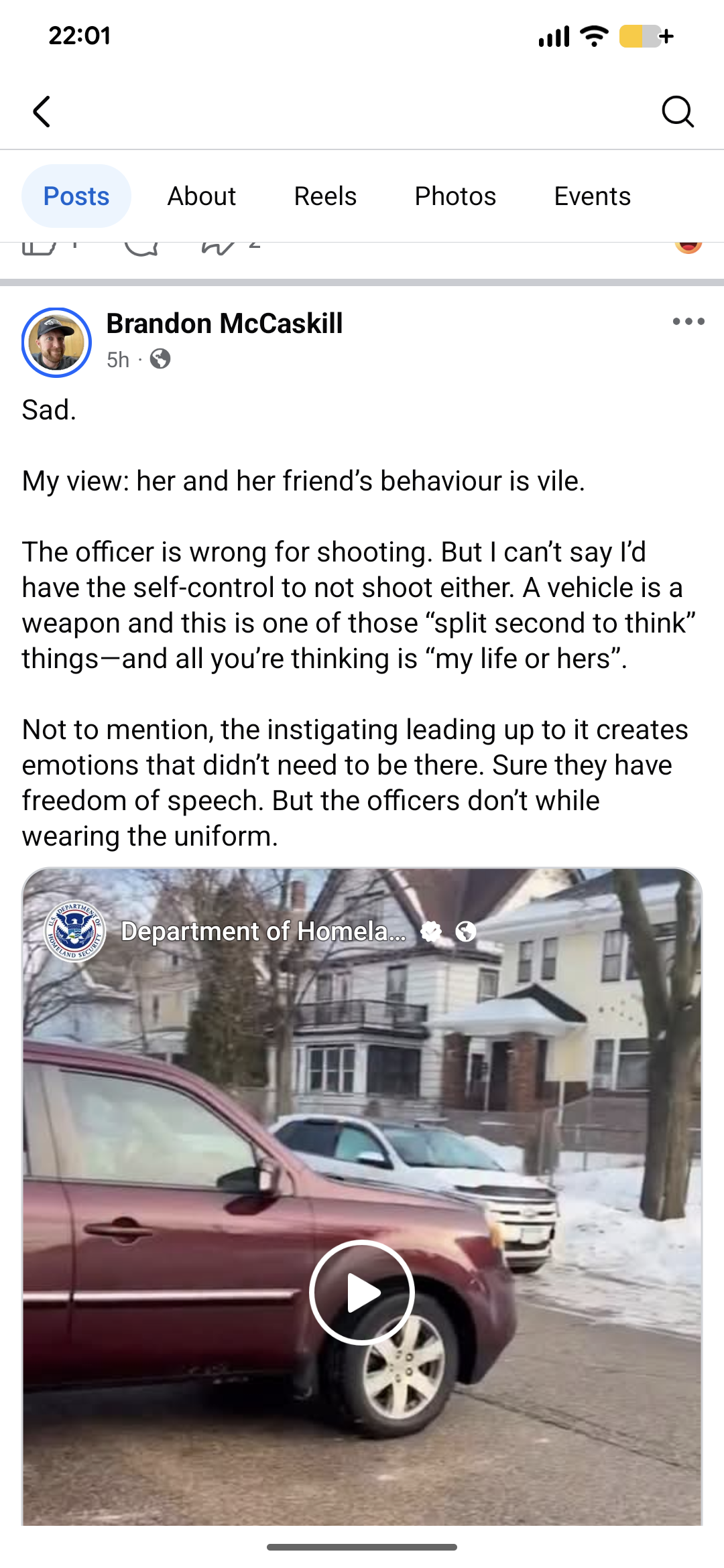
Brandon McCaskill wrote this post and I just needed to say something.
We know what copaganda looks like when it comes from police unions and mainstream media outlets. It is the passive voice in the headlines and the immediate release of the victim’s past mugshots alongside the breathless emphasis on the officer’s fear. But we need to talk about the insidious and localized version of copaganda that lives in the comment sections of our neighbors and acquaintances. It is the mental software running in the heads of nice and reasonable people that allows them to process state murder without ever questioning the state itself.
I saw Brandon McCaskill’s recent post about the police killing and I need to address it. I know Brandon. This isn’t a hateful or frothing defense of violence. It is something far more common and in many ways more dangerous. It is a calm and balanced attempt to find the middle ground between a corpse and her killer. It is a masterclass in the psychology of indoctrination.
When regular people bend over backward to rationalize the lethal violence of the state, they aren’t just sharing an opinion. They are performing a psychological defense mechanism. They are protecting themselves from the terrifying reality that the system they trust is a murder machine.
Brandon starts his post with a single word. Sad. This is emotional camouflage. By immediately claiming sadness, he positions himself as a compassionate observer. It signals that he is a good person who feels bad about death. But this abstract sadness serves a specific political purpose because it depoliticizes the event.
It treats a state murder as a tragedy like a car accident or a tornado rather than an atrocity committed by an armed agent of the government. It acts as a moral hall pass allowing him to feel virtuous without ever having to take a moral stand against power.
Before Brandon can even discuss the killing, he feels the need to condemn the victim. He says his view is that her behavior was vile. This is an obsession with respectability politics. It reveals a deeply internalized belief that human rights and safety are conditional rewards for compliance and politeness.
In the indoctrinated mind, if you are vile or loud or disruptive then you have forfeited your right to guaranteed safety. By labeling the victim vile, Brandon creates necessary psychological distance. It reassures him that he is not vile and therefore he is safe. He believes the system only hurts those who ask for it. It is victim blaming disguised as moral judgment.Then comes the inevitable pivot to the officer’s perspective.
Brandon claims this is a split second thing where the officer is only thinking about survival. This is a profound identification with power. We have to ask why so many average citizens find it easier to empathize with the trained and armed agent of the state than with the unarmed civilian.
Brandon projects himself into the officer’s shoes because he claims he would not have the self control either. He swallows the police union narrative whole. This myth conveniently erases the officer’s training and their escalation of the situation and the massive power imbalance and their systemic immunity. It reduces systemic murder to a forgivable human reflex. It humanizes the killer while leaving the victim labeled as vile.
Perhaps the most revealing part of Brandon’s post is his comment on the emotions of the situation. He says the instigating created emotions that did not need to be there. This is tone policing weaponized as a justification for death. The argument here is that emotion is the problem rather than the bullets. It reveals a deep societal discomfort with conflict and a demand for total submission to authority. He views challenging power as a moral failing that naturally leads to violence. The terrifying implication is that if you make a cop emotional, you are responsible for what they do to you. It infantilizes the officer who apparently cannot help their reactions and places the entire burden of de-escalation on the person staring down the barrel of a gun.
This type of commentary is not an attempt at compassion. It is a desperate attempt at comfort. To maintain faith in the status quo, Brandon must reconcile two conflicting beliefs. He believes killing is wrong but he also believes the police are good. When a cop murders someone, the cognitive dissonance is painful. To soothe that pain, he performs mental gymnastics. The victim must be bad. The situation must be unavoidable. The emotions must be provoked. This is the banality of evil in a Facebook status. It is polite and reasonable and utterly complicit in state violence. It proves that you do not need to be holding the gun to pull the trigger. You just have to be willing to explain away why it was necessary.
